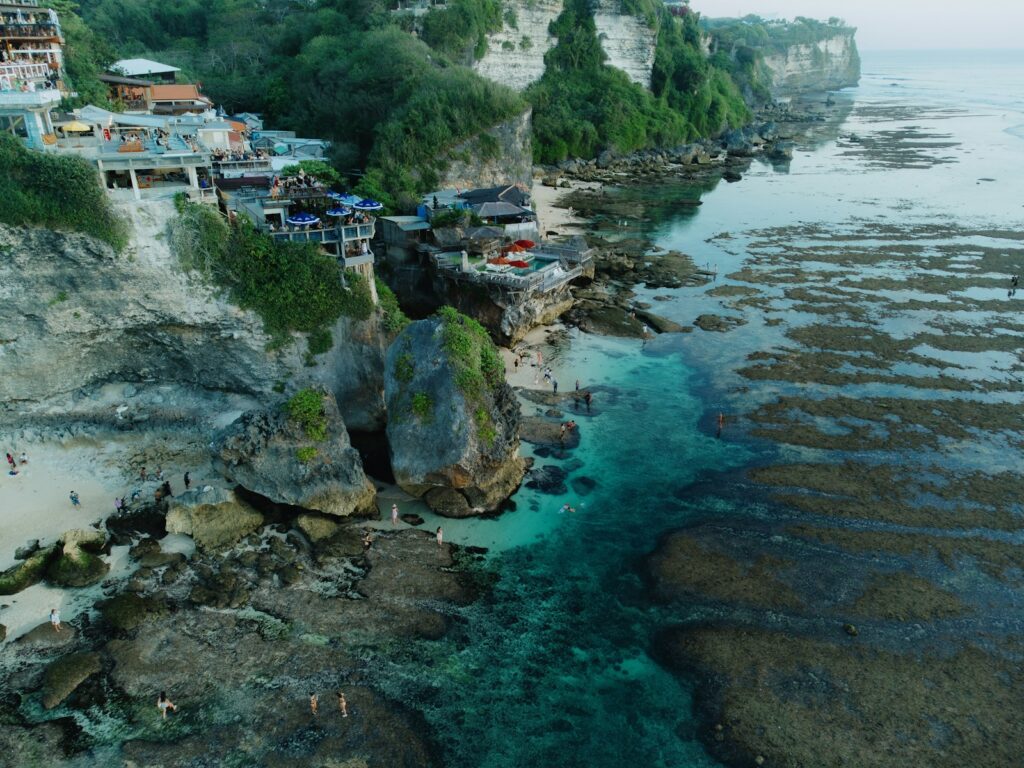
A helicopter proposal over Bali’s Uluwatu cliffs puts you roughly 800 metres above the Bukit Peninsula’s limestone edge, flying a 15-minute arc that tracks the southern coastline from GWK down to Uluwatu Temple — and that specific combination of sky, sea, and cliffs is exactly what makes a helicopter proposal at Bali’s Uluwatu cliffs genuinely difficult to equal on the ground. The geometry is simple: the Bukit drops straight into the Indian Ocean, the cliffs run for several kilometres, and from the air you can see every break and cove in one sweep. This piece covers the route in honest detail, how to coordinate a photographer, where the ring goes, and what all of it actually costs.
The Route You Actually Fly
Almost all Uluwatu scenic flights depart from the Fly Bali Heliport in Ungasan — located on Jl. Pantai Melasti, about 1.5 nautical miles from GWK. The stated 15-minute “Uluwatu Skyline” circuit is the standard product: the pilot lifts off, crosses GWK’s Garuda Wisnu Kencana statue, passes Melasti Beach and Pandawa Beach tucked into the cliff base, then continues south to Uluwatu Temple perched on the headland, skims past Nyang Nyang Beach, and returns. At typical light-single cruise speed that loop is genuinely achievable in 15 minutes.
A few things worth knowing before you book. At 10 minutes, you get the Bukit coastline without reaching the temple — the GWK-to-Pandawa stretch only. At 15 minutes, you get Uluwatu Temple in the frame if the pilot flies a tighter southern arc. Neither 10 nor 15 minutes will get you to Nusa Penida, Mount Batur, or any of the northern rice terraces — those require 40-plus-minute flights from a South Bali base. For a proposal the 15-minute circuit is the right call: it’s long enough for the moment and the photographs, short enough that neither of you is airsick from a long flight.
The specific beat where the cliffs are at their most dramatic — roughly between Padang Padang and Uluwatu Temple — lasts about three to four minutes of the circuit. That is your proposal window. Tell the operator in advance that you want to be facing the cliff face during that segment; they can instruct the pilot to orbit or slow the turn rate slightly. This is standard practice for proposal and photography flights and does not cost extra unless it extends total airborne time.
Private Charter Is Non-Negotiable for a Proposal
Balicopter’s published per-seat shared product puts a 15-minute Uluwatu tour at around IDR 3,390,000 per seat — roughly USD 210–230 per person at current exchange. For two people on a shared flight, that’s approximately USD 420–460. The problem: a shared flight means strangers in the back seats. You have no control over timing, the pilot is managing a mixed group, and whoever else is on board will be in every photograph.
A private charter of the entire aircraft is the only sensible format for a proposal. Based on published private-flight pricing from operators in the South Bali market, a 15-minute private Uluwatu circuit runs in the bracket of IDR 25–26 million, roughly USD 1,600–1,800 for the whole helicopter. Split two ways that’s USD 800–900 per person — more than the shared per-seat price, but you get the aircraft to yourselves and full control of the moment.
- Shared seat, 15-min Uluwatu circuit
- IDR ~3,390,000/person (approx USD 210–230/person) — strangers on board, no timing control
- Private charter, 15-min Uluwatu circuit
- IDR ~25–26 million/flight (approx USD 1,600–1,800 total) — aircraft to yourselves, pilot briefed on proposal timing
- Extended 30–35-min private charter (adds Canggu coastline)
- IDR ~30–36 million/flight (approx USD 1,900–2,300 total, inferred) — more flight time for photos, longer cliff exposure
- Doors-off photography upgrade
- Usually charged at a minimum 60-min block; expect USD 3,000–5,000+ for a dedicated photo flight. Not standard for a proposal circuit — most couples use a second camera person on the ground or a ground photographer at the departure helipad
Ask operators whether the quoted price includes the 10–21% Indonesian service and tax component. Raffles Bali’s documented brochure pricing is net-inclusive, but not every operator works that way. Get the all-in number in writing before you pay a deposit.
Coordinating the Photographer
This is where most proposals go wrong logistically. There are three realistic setups:
Photographer on Board
The cleanest option. You bring a photographer as the third passenger (most South Bali helicopters take 4–5 passengers; on a 15-minute circuit with two passengers plus photographer, weight is almost never the issue). The photographer shoots from the seat beside or behind you. They need to brief the operator in advance that they’re bringing camera equipment — a telephoto or medium zoom is fine; a large gimbal rig or drone is not. No doors-off setup is needed for this; standard cabin windows provide enough of a view on the cliff-facing bank of the flight.
Photographer on the Ground at Ungasan Heliport
Some photographers position themselves at the heliport departure pad and shoot the helicopter as it lifts and as it returns. This captures the arrivals moment — when you land and step out, ring on finger — rather than the airborne proposal itself. It’s worth doing as a supplement, not a replacement.
Photographer at a Clifftop Venue
If you’ve arranged a post-flight dinner at a clifftop restaurant in Uluwatu — Sundays Beach Club, Ulu Cliffhouse, or one of the Pecatu properties — a photographer can position at that venue for the landing or the dinner reveal. This works well as the second act of the evening.
Whichever setup you choose, share the flight plan and approximate timing window with your photographer. The operator can tell you what bearing the helicopter will be on during the cliff segment and roughly how long after takeoff. A good aerial photographer knows to ask the operator for the flight track.
The Ring: Where It Goes and Why It Matters
Helicopters are loud, they vibrate, and a 15-minute flight at low altitude over the ocean creates real anxiety for anyone holding a small object over open doors. Standard proposal flights are closed-door — not doors-off — so the ring is not at risk of going overboard. But the vibration and the moment itself mean you do not want to be rummaging in a jacket pocket mid-flight.
Best practice: keep the ring box in a zipped inner pocket of whatever you’re wearing, not a loose outer pocket. Brief yourself before boarding on exactly how you’re going to retrieve it — the proposal moment on the cliff pass should feel unhurried, not like you’re searching for your boarding pass. Some people hand the ring to the pilot before the flight so the pilot can pass it back at the right moment; this works but requires a very specific pre-flight conversation and trust in the execution chain.
If you’ve arranged flowers or champagne on board — some operators offer a flower drop or pre-loaded champagne as an add-on, priced separately and arranged via the operator’s concierge team — confirm those are secured during takeoff and landing. A loose bottle in a turbulent cabin is a mess.
Surprise Logistics: Keeping It Secret Until Airborne
The surprise mechanic is simpler than it sounds. You book the flight under a cover story: a sunset aerial tour, a birthday gift, an “I just wanted us to see Bali from the air” framing. Your partner needs to know to be at the heliport at the right time and dressed appropriately — this is not a muddy hiking trip. Sandals or heels are both fine; the heliport at Ungasan is a paved, staffed facility. Most operators require closed-toe shoes for safety, so give your partner a heads-up on footwear without revealing why.
Tell the operator’s ground team and the pilot about the proposal before the day. They will not spoil it — operators run these regularly and they’re practiced at keeping a straight face through the pre-flight briefing. Ask them to brief your partner on safety without mentioning anything proposal-adjacent. Some operators have a specific marriage-proposal package with a dedicated coordinator; if yours does, use it. If not, a direct email to the charter team with “surprise proposal” in the subject line is enough to get the pilot briefed.
Timing-wise: the cliff segment comes roughly eight to ten minutes into a 15-minute Uluwatu circuit, after GWK and the northern Bukit beaches. If you want to propose at that exact moment, you need to be watching out the right-side window (the cliff-facing side) and have signalled to the pilot beforehand — a nod, a hand gesture, whatever you’ve agreed — so the pilot knows to hold the bank angle through that segment.
When to Fly: Time of Day and Season
South Bali scenic flights typically operate between 10:00 and 16:30 daily. That window covers two distinct lighting conditions: midday (harsh overhead sun, flat on the cliffs) and late afternoon (golden-hour warm light from roughly 15:30 onwards, cliffs lit from the west). For photographs, the 15:00–16:30 slot is significantly better. The sun sits low enough to rake across the cliff face and Uluwatu Temple rather than bleach it out from directly above.
Sunset-specific flights — departing around 17:00–17:30 for the full golden hour — do exist as special charters and command a premium. Not all operators offer them within the standard published window; ask specifically and expect the price to reflect the extended day-end slot.
Seasonally, the dry season from April to October gives the most reliable visibility and the fewest cancellations. The wet season from November to March brings afternoon thunderstorms, low cloud on the Bukit, and more last-minute go/no-go calls. Proposal flights in the wet season are possible — the south Bali coast clears more often than the volcano and mountain routes — but build a backup date into your planning. A reputable operator will reschedule rather than fly in poor visibility; confirm their weather-cancellation and rebooking policy before paying a deposit.
Book at least one to two weeks out for a peak season Saturday or sunset slot. During July–August and Christmas–New Year the South Bali heliport is busy. If you have a specific anniversary date in mind, two to three weeks’ notice is safer.
Add-Ons Worth Considering (and Some Not Worth the Cost)
Worth it: a pre-or-post-flight dinner reservation at a clifftop restaurant in Uluwatu. The helicopter is the proposal; the dinner is the celebration. Ulu Cliffhouse, Sundays Beach Club, and the Bulgari resort restaurant (for guests) are all within minutes of the Ungasan heliport. A car and driver from the heliport to any of those venues is a 10–15-minute ride.
Worth it if you’re already spending on photography: a 30–35 minute charter instead of 15 minutes. Balicopter’s “Canggu and Uluwatu Two Coastlines” product runs 35 minutes at around IDR 7,990,000 per seat shared — on a private basis that would be in the IDR 30–36 million range (inferred, confirm with the operator). The extra 20 minutes adds the Seminyak and Canggu coastline on the return, giving your photographer more cliff-and-sea frames.
Think carefully before paying for: onboard champagne poured mid-flight. Helicopter cabins are small, turbulence is real, and you’ve just had an emotionally charged moment in a loud aircraft. Most couples prefer to wait until their feet are on the ground. Ask the operator whether they can have champagne waiting at the helipad on landing instead — it’s a more composed moment.
Not worth it for a proposal specifically: a full doors-off photography charter. These are genuinely impressive for content creators, but they require a minimum block of 60–90 minutes, the setup is operationally complex, and the cost (USD 3,000–5,000+) doubles the overall spend without meaningfully improving the proposal itself. A good photographer in the cabin on a 15-minute private circuit will capture everything you need.
Ready to lock down the details? Plan your trip with our concierge — share your date and what you’re after and we’ll help you cross-check operator availability, compare pricing, and make sure the logistics hold together. We’re also reachable via WhatsApp if you need a quick answer on timing or pricing ranges before you commit.
Cost Summary: What to Budget
| Item | IDR (approx) | USD (approx) | Notes |
|---|---|---|---|
| Private 15-min Uluwatu circuit | 25–26 million | USD 1,600–1,800 | Whole aircraft; confirm tax-inclusive |
| Photographer on board (3rd seat) | Photographer fee only; seat often included in charter | USD 300–700+ for a professional aerial photographer | Confirm camera equipment OK with operator |
| Flowers / champagne add-on | Variable; ask operator | USD 50–200 | Better arranged on landing than in-flight |
| Post-flight dinner (Uluwatu clifftop) | 800k–3M+ depending on venue | USD 50–200+ | Book separately; 10–15 min drive from heliport |
| Ground return transfer (Nusa Dua / Jimbaran / Ungasan) | Included by some operators; otherwise IDR 150–300k | USD 10–20 | Confirm at booking |
Total realistic budget for the proposal flight itself: IDR 25–30 million, approximately USD 1,600–2,000, before photographer and dinner. A full evening including photographer, clifftop dinner, and transfers lands in the USD 2,500–3,500 range depending on your dinner venue and how much you spend on photography.
Frequently Asked Questions
Can the pilot actually hear you propose, or is it too loud?
The cabin of a Bell 505 or Robinson R66 is genuinely loud at altitude — both you and your partner will be wearing aviation headsets for communication. Most couples either remove the headsets for the proposal moment or simply accept that the pilot hears everything. Pilots are professionals who have seen this before, and the moment reads clearly even through a headset. If the idea of an audience bothers you, remove the headsets for 30 seconds; you lose two-way communication but the pilot knows to hold course.
What if the weather is bad on our proposal day?
Reputable operators make a go/no-go call on the morning of the flight based on current conditions. If they scrub a flight for weather, the standard policy is a reschedule or a full refund — confirm this in writing when you pay the deposit. In the wet season (November–March) build a one-day buffer date into your plans. The south Bali coast clears more predictably than the volcano routes, but afternoon storms can roll in fast; an early-afternoon departure slot is safer than last light in November.
Is it possible to have a photographer shooting from outside the aircraft — doors-off — for the proposal?
Technically yes, but it is not the standard setup for a 15-minute proposal circuit. Doors-off flights require specific aircraft approval, harnesses, and additional safety protocols; they are almost always sold as dedicated 60-to-90-minute photography charters rather than short scenic blocks. For a proposal, a photographer seated inside the cabin shooting through the window produces excellent results at a fraction of the complexity and cost. If aerial photography is a primary goal on its own terms, that is a separate booking conversation.
How much notice do operators need for a proposal flight?
For a standard private charter, one to two weeks is comfortable outside peak season. During July–August and December–January, two to three weeks is safer for a specific date. If you need a sunset or special-timing slot, give yourself as much lead time as possible — those slots are limited and popular. Many operators can accommodate shorter notice in shoulder season (April–June, September–October) but availability is never guaranteed.
Do I need to tell my partner anything about the flight before the day?
You need to brief your partner on two practical points without giving away the proposal: closed-toe shoes are required (sandals are usually rejected at the safety check), and the departure is from the Ungasan heliport in South Bali. Everything else can be framed as a surprise experience. Some operators offer to send a generic “scenic flight confirmation” email to your partner’s address as a cover — ask if that’s available. It sounds elaborate, but it solves the footwear problem cleanly.
If you want help comparing operators, checking current availability, or understanding what’s actually included in a specific quote, reach out to our planning team. We’re independent — no favoured operators, no paid placement — and we can help you cut through the WhatsApp-only booking process that most Bali helicopter companies run. We’re also on WhatsApp for quick questions if that’s easier.