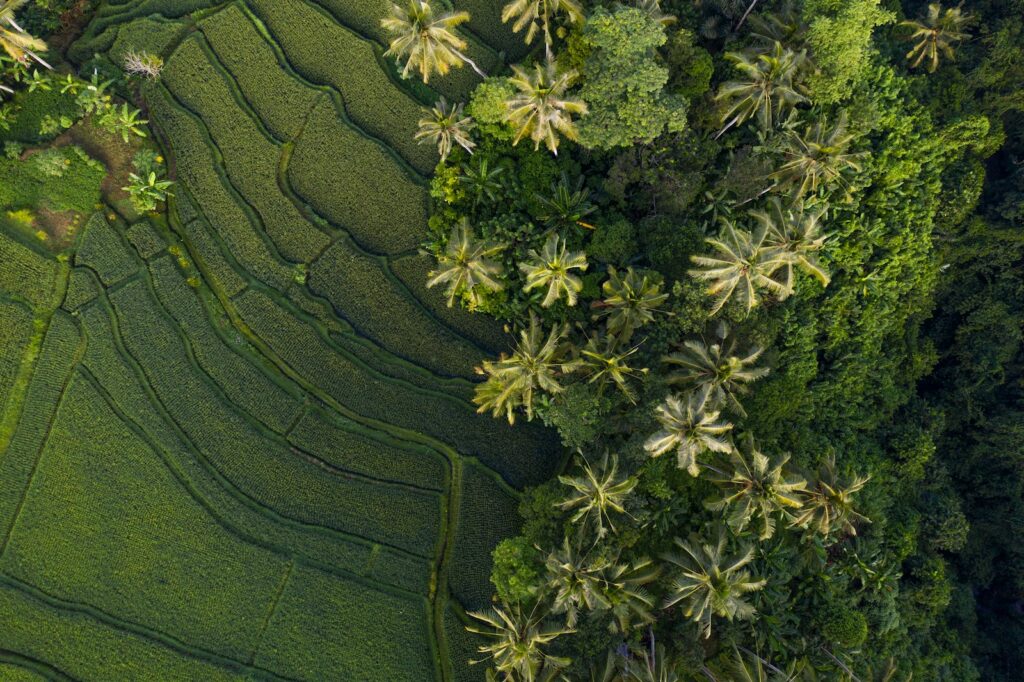
An Ubud helicopter tour is a 45-to-75-minute scenic flight that crosses central Bali’s jungle interior, passes over the Tegallalang or Jatiluwih rice terraces, traces the Ayung River gorge, and swings west to finish above Tanah Lot temple on the coast. Ubud helicopter tour prices run from roughly IDR 14,900,000 per seat on shared scenic routes up to IDR 65,000,000–IDR 70,000,000+ per helicopter for a private grand-tour charter covering the same ground plus the volcanoes. Those numbers reflect what the market actually charges in 2025–2026 — not the misleading “from” teasers that operators splash on booking pages.
One thing to say clearly before we get into the detail: there is no such thing as a 15-minute Ubud helicopter tour. Ubud sits roughly 25–30 km inland from the South Bali heliport bases at Ungasan and Jimbaran. At typical light helicopter cruise speeds, the flight to the rice terrace zone and back eats at least 20 minutes of airtime before you’ve seen anything. Any operator quoting you a “30-minute Ubud flight” is counting a fast transit with minimal loiter time over the terraces. Realistic sightseeing routes start at 45 minutes, and the most complete — the kind that does Ubud, Jatiluwih, the Ayung, and Tanah Lot — take 60–75 minutes or more.
What You Actually See on a Helicopter Over Ubud
The Ubud zone rewards a low, slow pass more than almost any other part of Bali. Here’s what to look for window-by-window on a well-routed 60-minute bali jungle and temple scenic flight:
Ubud Town and the Monkey Forest Canopy
Approaching from the south, the density of Ubud’s tree cover surprises most first-timers. From 1,500–2,000 feet you can pick out the Pura Taman Saraswati lotus pond, the palace grounds, and the dark-green mass of the Sacred Monkey Forest ravine. Luxury resorts carved into the Ayung gorge — think the terraced rice-paddy pools of the Komaneka or the cliffside villas of the Capella — are clearly visible if the pilot follows the river.
The Ayung River Gorge
The Ayung cuts a deep ravine through volcanic soil, and from the air the contrast between the white-water rapids below and the dense tropical canopy above is sharp. Rafting groups look tiny. The terraced resort gardens on the gorge walls stand out in the late-morning light when the sun is still low enough to cast shadow into the valley. This is the section that separates a thoughtful routing from a lazy transit altitude.
Tegallalang Rice Terraces
Tegallalang, about 8–10 km north of Ubud town, is the most-photographed terrace complex on the island. From a helicopter, the stepped geometry of the subak irrigation system fills the cockpit window in a way that no drone shot or Instagram grid quite captures. The light turns the flooded paddies into a mirror grid at certain angles in the dry season; during the growing season the tiered rows are an almost surgical green. Most operators target a pass altitude of 1,000–1,500 feet here for the best visual spread.
Jatiluwih Rice Terraces (UNESCO Heritage)
Jatiluwih sits 25–30 km further northwest of Tegallalang, at higher elevation in the foothills of the Batukaru range. It’s a UNESCO World Heritage Site — part of the Subak cultural landscape inscription — and it looks it from the air. The terraces are wider, older, less manicured-for-tourism, and they wrap around the hillside in organic curves rather than the steep uniform steps of Tegallalang. A dedicated Jatiluwih rice terrace helicopter flight needs a route that heads northwest toward Batukaru; operators who bundle Jatiluwih into their route descriptions are flying a longer arc than the pure Tegallalang pass. The Raffles Bali 2026 brochure confirms Jatiluwih on the 1h15m route: Sanur – Ubud – Mt Batur – Jatiluwih – Tanah Lot – Nuanu – Kuta Beach.
Tanah Lot Temple
Tanah Lot sits on a sea stack about 100 metres offshore on Bali’s west coast, surrounded by crashing surf. At low tide the base is walkable; at high tide the temple is an island. From a helicopter, the geometry is startling — the black-stone pagoda against white foam and turquoise water, with the gentle hill of the Tanah Lot estate behind it. A tanah lot temple helicopter tour bali routing sweeps in from inland across the coastal scrubland before the sea stack appears suddenly below. Sunset timing matters a lot here; the west-facing cliffs are lit perfectly in the last 90 minutes of daylight.
Route Duration: Why 45–75 Minutes Is the Honest Minimum
The documented routes in operator brochures confirm what the distances require. Mason Adventures operates a 60-minute Batur + west coastline + Tanah Lot combination. The Raffles Bali 2026 brochure shows a 1h06m Kintamani–Batur–Ubud–Tanah Lot routing and a 1h15m Sanur–Ubud–Batur–Jatiluwih–Tanah Lot route. A 75-minute “Bali Volcanoes & Temples” package appears in Balicopter’s published rate sheet at IDR 14,990,000 per seat.
The reason these routes are long is simple arithmetic. Fly south from Jimbaran, turn inland at Ubud (20–25 minutes of airtime), loop over Tegallalang, push northwest to Jatiluwih if the route includes it, swing down to the coast at Tanah Lot, and return east to base. That’s 60–80 minutes of actual flying before fuel, weight-and-balance, and operator scheduling decisions trim or extend it.
A 30-minute flight can get you to Ubud and back, but you’re looking at the terraces for about five minutes at altitude before turning for home. Mason also operates a 30-minute Batur-focused route, but that’s volcano–caldera only: Tanah Lot and Ubud are not on it. If someone quotes you a 30-minute “Ubud and Tanah Lot” tour, ask them to draw the route on a map. The maths won’t work.
Ubud Helicopter Tour Price: What to Expect in IDR and USD
Two distinct pricing structures exist in this market: per-seat shared scenic and per-helicopter private charter. Both have their logic. Neither is straightforwardly “cheaper” once you account for group size.
Per-Seat (Shared Scenic) Price Brackets
| Route type | Approx. duration | IDR / seat (approx.) | USD / seat (approx.) |
|---|---|---|---|
| Volcano focus only (Batur + caldera) | 30 min | 5,000,000–7,000,000 | 310–450 |
| Batur + Tanah Lot coastal loop | 60 min | 10,000,000–14,990,000 | 625–950 |
| Ubud + Batur + Jatiluwih + Tanah Lot (full inland route) | 75 min | 14,990,000–18,000,000 | 940–1,130 |
| Grand tour (adds islands or Agung) | 85–100 min | 16,990,000–20,990,000 | 1,060–1,310 |
Balicopter publishes a “Bali Volcanoes & Temples” route at IDR 14,990,000/seat for 75 minutes. That’s the most directly applicable published per-seat benchmark for this route type. The IDR 10,990,000 Balicopter “Four Islands Best” (55 minutes, islands-focused) is cheaper per minute but covers a different route entirely.
Per-Helicopter Private Charter Price Brackets
Private charter means you buy the whole aircraft — typically 4 to 6 seats depending on the helicopter type. No strangers in the cabin. You can choose your altitude, ask for an extra pass over the terraces, and stop for a photo hover if the pilot’s schedule allows. The Raffles Bali 2026 brochure gives real per-flight figures for grand-tour lengths:
- 60-minute private Batur–Ubud–Tanah Lot circuit
- IDR 61,000,000–66,000,000 per flight ≈ USD 3,800–4,300. Split four ways: roughly USD 950–1,075 per person — nearly the same as a per-seat rate but with full control of the cabin and routing flexibility.
- 75-minute private with Jatiluwih
- Expect IDR 65,000,000–75,000,000 / helicopter ≈ USD 4,000–4,700 at current FX. Not published by all operators; treat this as an informed estimate until you get a firm quote. Verify directly.
- 30-minute express Ubud transfer/scout
- No operator publishes this as a scenic route. But as a point-to-point transfer, Fly Bali markets the Ubud helicopter transfer at IDR 5,990,000/seat, 15 minutes block time. A 30-minute bespoke flight would likely sit in the IDR 22,000,000–30,000,000 range per helicopter — figure inferred from block-time pricing, not operator-published. Ask for a quote.
The Break-Even Calculation
If there are four of you, a per-seat rate of IDR 14,990,000 costs IDR 59,960,000 in total. A private charter for the same route at IDR 62,000,000 costs IDR 2,040,000 more — about USD 130 — but gives you the whole aircraft, flexible routing, and no scheduling dependency on fill rate. For groups of four or more on long routes, private charter frequently beats four per-seat tickets on value. Run the numbers before you assume “per seat is cheaper.”
If you’re planning a longer itinerary and want help running those numbers for your group size, reach out to our concierge or drop a message on WhatsApp — we’ll pull operator quotes and do the maths before you commit to anything.
The Best Light for Green Terraces
Rice terrace photography has a narrow window. The terraces are at their most dramatic colour — that deep, almost electric green — during the growing season, roughly March through August for most of the Ubud zone, though Jatiluwih’s higher elevation means its cycles run slightly differently. Outside the growing season, some paddies are golden-harvest amber and some are bare brown earth. Neither is “wrong,” but if vivid green is the image you’re planning around, confirm the season before you book.
Time of day matters more than most operators tell you. The terraces face roughly east, so morning light (07:30–10:00) hits the stepped walls at a low angle and creates the shadow depth that makes the geometry pop in photographs. By noon, direct overhead sun bleaches the paddies flat. Late afternoon brings warm light but the sun is now coming from the west — useful for Tanah Lot, less useful for east-facing terrace walls. If your priority is the terraces, push for a morning departure. If Tanah Lot sunset is the goal, go late — but understand that the terraces will be in flatter light on the way out.
Dry season (April through October) is more reliable for visibility, fewer cloud interruptions, and cleaner air. The wet season (November through March) can still produce clear mornings, but afternoon thunderstorms are common and operators make go/no-go calls within hours of departure. Expect more rescheduling friction in the wet months.
What Gets Bundled (and What Gets Added)
Most operators who market a helicopter over ubud rice terraces are actually selling a volcano-plus-culture routing that includes Mount Batur and the caldera as the other visual centrepiece. That’s logical — both landmarks are in the interior, and flying past the volcano adds dramatic contrast to the green terrace passes. If the Batur crater section doesn’t appeal to you (volcanic grey versus green terraces is jarring for some), check whether a terrace-and-coast-only routing is available, or negotiate a custom charter path.
For Tanah Lot specifically: the temple sits on Bali’s west coast, roughly 18–22 km southwest of Jatiluwih and 25–30 km west of Ubud. An operator’s 75-minute route that genuinely covers all three — Ubud jungle, Jatiluwih terraces, Tanah Lot — is flying a wide arc across central and west Bali, returning east to base along the coast. That’s a real 75-minute trip, not a padded one.
Typical Inclusions and Watch-Outs
- Usually included: pilot, headsets (noise-cancelling Bose on some operators), pre-flight safety briefing, and return to base heliport.
- Sometimes included: hotel ground transfer to/from the helipad (Ungasan/Jimbaran base, within South Bali), bottled water.
- Often not included: 10–21% Indonesian tax and heliport fees. Always ask whether the quoted price is net (tax-inclusive) or plus-tax. The Raffles Bali pricing appears tax-inclusive; not all operators follow that convention.
- Never assume: doors-off photography configuration, champagne, professional photographer on board, or extended loiter time are included in a standard scenic package. These require a separate booking and explicit confirmation.
Helipads and Departure Points
All documented tours for this route depart from South Bali — not from Ubud itself. There is no commercial helipad in Ubud town centre for scheduled scenic departures, though some luxury resort properties (Komaneka, Four Seasons Sayan) have pads that may be used for private charter pickups by prior arrangement and with DGCA-compliant landing clearance. Confirm this directly with the operator; “can you pick me up from my resort?” is worth asking if you’re staying in the Ayung gorge.
The primary South Bali departure bases are:
- Fly Bali Heliport, Ungasan (Jl. Pantai Melasti no. 8) — the most commonly referenced licensed heliport, about 5.5 nautical miles from Ngurah Rai airport, close to Alila Uluwatu, Bulgari, and Ayana.
- Raffles Bali Helipad, Jimbaran — used as the base for Raffles’ own documented scenic routes.
- Balicopter heliport, South Bali — coordinates not publicly published; confirm at booking.
Travel time from Seminyak or Kuta to the Ungasan heliport runs 30–45 minutes in typical daytime traffic. From Canggu, add another 10–20 minutes. If the operator’s package includes a ground transfer, clarify the pickup window and cutoff time. Missing the departure slot for weather-window reasons is more consequential here than for island routes — the morning light over the terraces won’t wait.
For the cross-link context: this route connects naturally with the Mount Batur volcano helicopter tour page (most operators bundle the two anyway) and with our Bali helicopter tour master guide for broader pricing context. The helipad locations directory covers all South Bali departure points in detail. If you’re wondering how much you can actually see in a shorter flight, the 30-minute flight guide explains the route maths plainly.
Weight Limits, Passengers, and the Practicalities
Light helicopters operating scenic tours in Bali typically hold four to five passengers plus the pilot, but weight — not seat count — is the binding constraint. Operators commonly enforce a soft limit of around 100–120 kg per passenger, and total payload limits (passengers plus luggage) typically range from 320 kg (Balilook’s published figure) to 350 kg (Fly Bali’s published figure) depending on the aircraft type and fuel load for the route.
On a 75-minute inland route to Jatiluwih and back, fuel load is heavier than a 15-minute coastal hop. That means available payload for passengers is correspondingly smaller. Four larger-framed adults may find the operator needs to reduce to three passengers, adjust the fuel plan, or reroute. Declare your group’s approximate weights honestly at booking — discovering the weight issue on the helipad is far worse than resolving it in advance.
Luggage on scenic tours should be minimal: a daypack, not a rolling suitcase. Camera gear is fine within reason; tripods and large video rigs need advance approval. Children are generally allowed; confirm minimum age and whether a child occupies a full seat (weight-wise, they usually do).
Planning Your Booking
Bali’s helicopter operators price and schedule these longer routes differently from the short coastal hops. Key points:
- Book 1–2 weeks ahead for peak season (July–August, Christmas–New Year, Nyepi/Galungan periods). These 60–75-minute routes fill faster than the 15-minute tasters because fewer seats are available per operating window.
- Morning slots go first. The 07:30–10:00 window is popular for photography-motivated bookings. Confirm your preferred time when you enquire, not after you’ve paid.
- Weather cancellation policy. Reputable operators will reschedule or credit; the question is the timeline (same-day credit vs. advance rebooking) and whether a cash refund is on the table. Get this in writing. A cancellation on a 75-minute grand-tour charter is a bigger financial exposure than a 15-minute coast hop, so the policy matters more here.
- Discounts are real but seasonal. Balicopter publicly lists a 10% promo on certain transfer routes; other operators do informal shoulder-season discounts. Low season (November–March, minus Christmas) is when to push for a reduction on private charters, not during the July–August rush.
Ready to price a specific date and group size? Use our concierge form or message us on WhatsApp and we’ll help you compare operator quotes side by side, no spin.
Frequently Asked Questions
How much does an Ubud helicopter tour cost per person?
For a shared per-seat scenic route that genuinely includes the Ubud rice terrace area and Tanah Lot, budget roughly IDR 14,990,000 to IDR 18,000,000 per person (approximately USD 940–1,130 at current rates). Shorter routes that cover the Batur volcano only are cheaper — around IDR 10,990,000–12,990,000/seat — but do not include the inland terrace zones. Always confirm exactly which landmarks are on the route before booking.
Can you see the Jatiluwih rice terraces from a helicopter in Bali?
Yes, but only on longer routes specifically routed northwest toward the Batukaru foothills. The Raffles Bali 2026 brochure confirms Jatiluwih on a 1h15m routing (Sanur – Ubud – Mt Batur – Jatiluwih – Tanah Lot). Tegallalang, which is closer to Ubud town, appears on shorter 60-minute routes. If Jatiluwih specifically is the draw — it’s the UNESCO-designated subak landscape and broader than Tegallalang — ask operators explicitly whether their “rice terrace” route goes there or stops at Tegallalang.
Is Tanah Lot included in a standard Ubud helicopter tour?
Not automatically. Tanah Lot sits on the west coast, a meaningful detour from the Ubud inland loop. It appears on 60–75-minute routes that extend west from the terrace zone to the coast before returning to base. Shorter routes — even ones billed as “Ubud and temples” — may mean the Pura Taman Ayun temple (near Mengwi, closer and easier to route) rather than the sea-stack Tanah Lot. Confirm with the operator by asking: “Does this route fly over the Tanah Lot sea stack on the west coast?”
What is the best time of day to fly the Ubud and Tanah Lot route?
Morning departures (07:30–10:00) are best if rice terrace photography is the priority — low sun angle creates the shadow depth that makes the subak geometry dramatic. If Tanah Lot sunset is the main goal, take the late-afternoon slot (the temple faces west and is lit perfectly in the last 90 minutes of daylight), but accept that the terraces will be in flatter, overhead light on the way out. Dry season (April–October) gives the most reliable visibility; wet-season mornings can still be clear, but afternoon turbulence and cloud build faster.
Is a private charter or per-seat ticket better value for the Ubud route?
For groups of four, the maths often favour private charter. A per-seat rate of IDR 14,990,000 for four people totals IDR 59,960,000. A private charter on a comparable route typically starts around IDR 61,000,000–66,000,000 per helicopter — a difference of IDR 1,000,000–6,000,000 (roughly USD 60–375) for full control of the cabin, routing flexibility, and no dependence on minimum fill rates. For two people, per-seat is almost always cheaper. The break-even point is usually three to four passengers depending on the exact operator and route length.