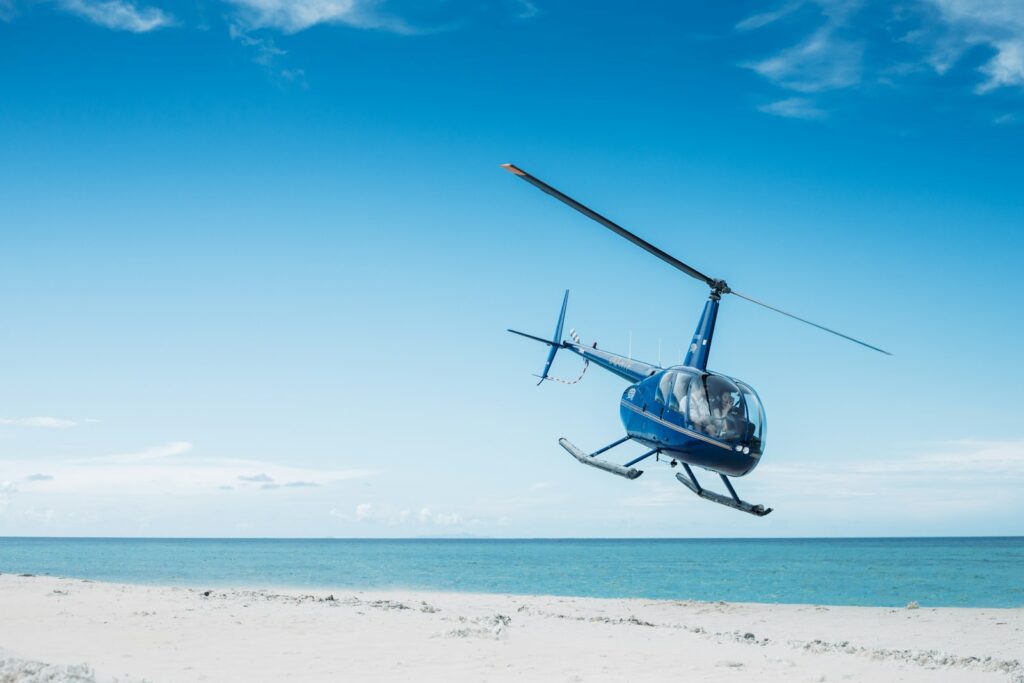
A Bali doors-off helicopter flight costs roughly USD 3,000–5,000 or more for a dedicated aerial photography or video charter — considerably more than a standard scenic tour — because the flight profile is fundamentally different. You are not flying a fixed scenic loop at cruise altitude; you are orbiting, hovering, and circling specific landmarks repeatedly at low altitude, which burns significantly more fuel and demands a pilot willing to work the aircraft hard for your shot list. This page covers what that price buys you, what the gear and clothing rules actually require, and which routes and timing windows produce the results that justify the cost.
Doors-off photography charters are not a click-to-book product anywhere in Bali. Every one is arranged by email or WhatsApp, usually a week or more in advance, and the price is quoted per flight rather than per seat. Understanding the mechanics before you call an operator will save you time and stop you from comparing this product against standard per-seat scenic rates.
What “Doors-Off” Actually Means in Bali’s Helicopter Market
In a standard scenic helicopter tour, the doors stay on. You are seated behind glazed panels that are optically fine for looking through but introduce reflections, distortion, and a physical barrier between your lens and the scene. For casual sightseeing, this does not matter. For aerial content production — photography at shutter speeds that freeze white water against limestone cliffs, video that needs clean glass in every direction, drone-like framing through an open frame — a closed-door cabin is a genuine constraint.
Doors-off operation removes one or more cabin doors before departure, leaving the side of the aircraft fully open. You are secured in your seat by a properly fitted harness; the opening is exactly what it sounds like. The pilot can orbit landmarks at low altitude with the aircraft in a banked turn, giving a window-seat photographer a direct downward and lateral view without any glass in the way. This is the product that aerial photographers, content creators, and commercial videographers specifically book. It is also the product that requires the most preparation, the clearest operator briefing, and the most advance planning of any helicopter service in Bali. Booking a dedicated aerial video crew — for example through Juara Production — is a separate arrangement from the aircraft itself.
Bali Doors-Off Helicopter Flight Price: What You Should Expect to Pay
The short version: budget USD 3,000–5,000 for a 60-minute shoot charter, and expect prices to climb from there for longer sessions or more complex route requirements. Some operators position premium aerial video production packages above USD 5,000 when they are providing pilot expertise, extended orbiting time, multiple passes over specific landmarks, and coordination with ground-based photography teams. The figures below are market brackets, not published rate cards — Bali operators quote doors-off pricing individually because each shoot has different requirements.
| Session length | Typical price bracket | What it covers | Notes |
|---|---|---|---|
| 60 minutes | ~USD 3,000–3,800 | One route focus (e.g. Nusa Penida cliffs, or South Bali coastline); 2–3 orbiting locations | Minimum practical session for serious photography; effective hourly rate very high due to orbiting fuel burn |
| 90 minutes | ~USD 4,200–5,500 | Two route zones (e.g. Penida cliffs + Lembongan channel); multiple passes per landmark | Most popular for commercial content; allows re-runs if first orbit angle misses |
| 120 minutes | ~USD 5,500–8,000+ | Extended multi-zone (South Bali coast + Penida + Batur, or full production day) | Upper end overlaps with full-day charter rates; confirm fuel, pilot rest, and permit requirements for longer routes |
Why so much more than a standard scenic flight? The price difference comes down to three factors. First, fuel burn: a helicopter orbiting and hovering at low altitude burns fuel at roughly two to three times the rate of cruising at transit altitude. A 60-minute photography session at orbiting altitude costs the operator significantly more in fuel than a 60-minute cruise tour. Second, pilot workload: doors-off orbiting requires a skilled pilot to hold precise positions, manage airspeed and altitude simultaneously, and make multiple passes on request — this is a different skill set from a standard tour routing. Third, minimum block time: even a 30-minute actual shoot involves pre-flight setup, harness fitting, doors-off rigging, and post-flight restoration, so operators charge for the full operational block.
Compare that against standard Balicopter published tour pricing: their 45-minute Nusa Penida tour runs IDR 8,999,000 per seat (approximately USD 560–600) for a closed-door scenic overflight. A private charter for that same route runs roughly USD 2,500–2,900 for the whole aircraft. A doors-off photography charter over the same geography at the same duration starts from USD 3,000 and climbs depending on how many orbiting passes your shot list requires. You are paying a real and significant premium for the open door and the hovering flight profile.
One honest caution: very short doors-off flights — 30-minute sessions some operators mention — carry particularly brutal effective hourly rates. The setup overhead means the actual photography window is compressed, and the cost per usable shot goes up sharply. Most working aerial photographers find 60 minutes to be the practical floor for a dedicated shoot.
If you want to work through operator options and get current quotes for your specific shoot date and route, reach out to our concierge — we help photographers compare operators without the commission pressure, and we can flag which operators have active doors-off approval for specific routes. WhatsApp planning works well for this; most Bali operators are faster to respond there than by email.
Which Aircraft Is Used — and Why It Matters for Photography
Not every helicopter in Bali’s fleet is cleared for doors-off operation, and operators are not always forthcoming about which specific aircraft they will assign to your booking. This is worth pressing on before you confirm.
The main types operating in Bali for charter work include the Airbus AS350/H125 Écureuil (one pilot plus four to five passengers, a common workhorse for charter and scenic tours), the Bell 505 Jet Ranger X (confirmed in Bali via Urban Air Helicopters under AOC 135, one pilot plus four), and the Robinson R66 (one pilot plus four, confirmed in Bali tourism operations). Each type has different door configurations, harness mounting points, and weight-and-balance envelopes when operated doors-off.
For aerial photography specifically, the AS350/H125 is generally preferred because of its wider rear cabin opening, better lateral visibility angles, and more robust performance envelope at the low airspeeds used during orbiting. The Robinson R66 is lighter and can be more responsive to pilot inputs but has a smaller cabin opening and lower payload margin — important if you are traveling with a professional camera system, harness, and a second person. Confirm the aircraft type in your booking confirmation, not just the operator’s name.
Capacity matters too. Most photography charters fly with one pilot and one or two photographers, keeping the aircraft well within its weight-and-balance envelope for doors-off operation. Operators commonly enforce total payload limits of 320–350 kg including passengers and all gear — Fly Bali publishes 350 kg; BaliLook cites 320 kg for their operations. With a pilot, one photographer, and camera equipment, this is rarely a problem. Add a second shooter or a videographer with rigging gear and you need to do the maths in advance. Declare all equipment weights when you book.
Gear Rules: What You Can and Cannot Bring Aboard
Every operator will give you a pre-flight briefing that covers this, but knowing the rules in advance means you can pack intelligently and avoid discovering at the helipad that a piece of equipment will not be allowed on board.
Camera and Lens Requirements
All camera equipment must be physically secured to your body or the aircraft at all times. This is non-negotiable: an unsecured camera body at orbiting altitude and speed becomes a projectile risk to the aircraft’s tail rotor and to people on the ground. Accepted securing methods include professional camera harnesses (BlackRapid, Peak Design, and similar load-bearing strap systems with dual attachment points), wrist straps rated for the full weight of the body-plus-lens combination, and aircraft tether points where provided.
Long telephoto lenses — 400mm and above — are operationally viable for aerial photography from a helicopter if they are properly braced and your shutter speed compensates for vibration. In practice, the majority of doors-off aerial work in Bali uses wide-to-standard zooms (16–35mm, 24–70mm) because the value of the open door is the close-up low-altitude perspective, not the telephoto compression. A 70–200mm f/2.8 is the longest focal length most operators will have seen on a production shoot without specific discussion. Confirm with your operator if you plan to fly with anything longer.
GoPros and action cameras on helmet or body mounts are typically permitted but must be demonstrated to be securely attached before the flight. Loose GoPro pole mounts and extending arms are generally not allowed — if the camera extends outside the aircraft on a rigid arm that can catch airflow, operators will require it removed or reconfigured. A helmet mount or a chest harness mount is the safe default.
Drone equipment is an entirely separate category and is not permitted on or launched from a helicopter during a flight. If your project requires both helicopter footage and drone footage, those are separate production days with separate permits.
Clothing and Personal Equipment
The two non-negotiables are closed-toe shoes and no loose fabrics. Sandals and flip-flops are refused at every reputable helipad in Bali; the pilot’s reasoning is both safety (foot protection on boarding and disembarking from a moving-rotor environment) and practical (a sandal that comes off inside an open-door helicopter is a dangerous loose object). Wear footwear with secure ankle coverage.
Loose clothing — flowing scarves, wide-brimmed hats, loosely fitted jackets with open fronts — must be secured or left behind. Rotor downwash and the wind effect from a banked orbiting turn will rip anything unsecured out of the cabin. Long hair must be tied back. Operators will provide and fit harnesses on-site; most require that you wear the provided harness over a fitted base layer, not over a bulky parka. Dress in close-fitting, comfortable layers that you can secure the harness over cleanly.
Sun protection matters more than many photographers expect. At altitude, UV exposure is significantly higher than at ground level, and a 60-to-90 minute session in an open-door cabin with direct sun exposure is enough to burn exposed skin. Apply sunscreen before you board; a buff or thin balaclava for neck and face protection is practical and will not interfere with the harness fit.
Audio and Communication
Pilot communication in an open-door helicopter is via helmet headset — the operator provides this. The ambient noise level is high; if you plan to record audio during the shoot (for a documentary or social media production), discuss a wireless mic setup with your operator in advance. Some aircraft have audio mixing points; others do not. Plan your audio production separately from your visual production, and do not assume the pilot will accommodate post-production audio requirements that were not discussed at booking.
Best Routes for Aerial Photography in Bali
Three routes dominate doors-off photography charter requests in Bali, each with a distinct visual character and a specific set of timing requirements.
Nusa Penida Cliffs and the Ceningan Channel
The Nusa Penida loop is the most-requested doors-off route, and for good reason. From a photography standpoint, the combination of the Ceningan Channel’s turquoise shallows, the geometric precision of Broken Beach’s collapsed sea-cave ring, the T-Rex skull profile of Kelingking Beach’s headland, and the open ocean exposure of Manta Point gives you four visually distinct subjects in a single flight session.
Kelingking is the frame everyone wants, but it is also the most technically demanding. The skull profile — the feature that makes Kelingking visually legible from the air — is only visible from a specific westward approach angle at low altitude. From directly above, you see a cliff and a beach. From too high, the profile flattens. Doors-off charters over Kelingking typically involve multiple orbiting passes at varying altitudes to let the photographer test different approaches before committing to the frame. This is where orbiting time earns its cost.
The Ceningan Channel is best in the early morning. The turquoise colour that makes it distinctive in aerial photography is a function of the sun angle on the shallow white-sand bottom: too early and the water appears darker; past mid-morning the direct overhead angle reduces the colour saturation. A 07:30–09:30 departure window is the consistent recommendation for the channel section. If your shot list is Penida-cliffs-only and you are less concerned about the channel, a mid-morning departure (10:00–11:30) is viable, though afternoon sea breeze can introduce turbulence on the south-west approach to Penida’s cliffs.
Flight time to Nusa Penida from the South Bali helipads runs approximately 18–20 minutes one way. For a 60-minute doors-off session, you are looking at roughly 36–40 minutes of transit and 20–24 minutes of actual hovering and orbiting time over the landmarks. This is why 60 minutes is described as a minimum, not a comfortable target. A 90-minute session over the Nusa group gives you the transit time budget plus genuine multiple-pass opportunity over each main subject.
Mount Batur Volcano and the Caldera
Batur is a completely different visual register from the coastline work. The caldera — a broad volcanic basin with a dark lake filling the inner floor and the younger, active Batur cone rising from the centre — photographs well under oblique morning light that throws the crater edges into relief. The geological scale only reads cleanly from altitude; this is a route where a wider lens (16–24mm) tends to outperform longer focal lengths.
The key timing challenge at Batur is cloud formation. The mountain sits at around 1,700 metres above sea level, and convective cloud builds from mid-morning onward, especially during the wet season and in the shoulder months. Sunrise to 09:00 is the clearest window for Batur photography; departing from South Bali at or before 07:00 to reach the caldera by approximately 07:30–08:00 puts you ahead of the cloud build. This requires an operator willing to schedule a pre-standard-hours departure — confirm this explicitly, since most operators run standard operations from 10:00 onward and early slots require specific arrangement.
Transit time from South Bali to Batur is roughly 25–35 minutes depending on departure helipad and route. A 90-minute doors-off charter allows meaningful time over the caldera rim, a pass over Lake Batur, and potentially a run toward Kintamani and back before cloud forces a return. The 120-minute option allows a Batur session plus an Ubud rice terrace segment on the way back, which is a visually complete production day — the rice terraces at Jatiluwih (UNESCO) look entirely different from altitude than from the road-level tourist viewpoints.
South Bali Coastline: Uluwatu and the Bukit Peninsula
For a shorter doors-off session, or as the return leg of a longer charter, the South Bali coastline from GWK south to Uluwatu is the most operationally straightforward route. The Bukit Peninsula limestone cliffs are consistently photogenic: the white limestone faces against dark ocean, the surf-break geometry at Padang Padang and Bingin, the temple silhouette of Uluwatu on its headland, and the sweep of Nyang Nyang Beach visible only from the air all deliver high-value frames within a short transit from the South Bali helipads.
The Uluwatu section flies over operational temple grounds. Operators are generally aware of and compliant with applicable airspace and cultural sensitivity requirements in this area — confirm during your planning conversation that low-altitude orbiting over the temple specifically is permitted for your booking date. Some restrictions apply at certain ceremony periods.
For drone-free aerial content creation — the application where a helicopter genuinely cannot be replaced — the South Bali coastline is the easiest entry point. At a 60-minute doors-off rate, you get meaningful coast coverage without the extended transit time that Penida or Batur require. Best light is the classic golden-hour window: 06:30–08:00 for sunrise warmth on the limestone, or the late-afternoon window from 16:00–17:30 for low-angle directional light on the cliffs. The afternoon window is weather-dependent and more turbulent; morning is the safer choice for technically controlled photography.
Best Time for Helicopter Photography in Bali
The short answer: dry season (April through October), morning departure, ideally 07:00–10:00. That combination gives you the best light quality, the lowest turbulence, and the most reliable sky condition for aerial photography. Here is the full picture.
Season
Bali’s dry season (April through October) delivers the most predictable flying weather. Lower humidity means better visibility, especially on volcano routes where haze can significantly reduce clarity at Batur and Agung. Coastal routes are less affected by haze than mountain routes, but dry-season clarity still produces cleaner background skies and sharper horizon definition. July and August are peak tourist season for all Bali helicopter products, so book further ahead — two weeks minimum, three for a dedicated photography charter.
The wet season (November through March) does not make aerial photography impossible. Morning windows remain viable through much of it, and some coastal routes actually benefit from the dramatic cloud formations that build through the wet season — if your aesthetic runs toward moody, the wet season occasionally delivers skies that the dry season cannot. But the risk of same-day weather cancellation is meaningfully higher, and Batur routes become increasingly uncertain from November through February as cloud base drops. Build extra days into a wet-season shoot schedule and confirm your operator’s cancellation and rescheduling policy in writing before you pay a deposit.
Time of Day
Morning departures dominate aerial photography for two reasons: light quality and air stability. The golden-hour light from 06:30–08:00 provides directional warmth and long shadows that reveal coastal cliff topography in ways flat midday light cannot. More practically, Bali’s sea breeze typically kicks in between 10:00 and 11:00, introducing turbulence — particularly on south-facing coastal routes and on approaches to Penida’s south-west cliffs. A helicopter orbiting at low altitude in moderate turbulence is harder to shoot sharp from, regardless of image stabilisation. Smooth air is a meaningful advantage.
Afternoon shoots (16:00–17:30) are the second choice for light quality — the low sun angle produces good directional light on east-facing features. The risk is that afternoon cloud is more persistent and turbulence from the day’s heating has not fully died down. Late afternoon golden hour from a helicopter is occasionally spectacular and occasionally cancelled. Factor that uncertainty into your production plan.
Standard operator hours are approximately 10:00–16:30. Early morning departures are available for dedicated charters but need to be arranged explicitly — do not assume a 07:00 departure is possible without advance confirmation. Pre-dawn “sunrise over Batur” shoots require operators who are set up for it; most are not.
How to Book a Doors-Off Photography Charter in Bali
There is no standard online booking form for this product. The booking process is email or WhatsApp, and the conversation covers more ground than a standard scenic flight reservation.
- Step 1: Define your shot list before contacting operators
- Know which routes and landmarks you want, the approximate duration you are budgeting for, and your preferred departure window. Operators quote and schedule based on this information. “We want doors-off over Bali” is not a brief — “60-minute doors-off charter over Nusa Penida (Kelingking + Broken Beach + Ceningan Channel), morning departure, single photographer with AS350 or similar, first preference 08:00 departure” is a brief they can price and schedule.
- Step 2: Confirm doors-off capability on the specific aircraft
- Ask explicitly: is the aircraft that will be assigned to this flight certified for doors-off operation? What is the aircraft type and registration? Operators occasionally assign different aircraft than expected when schedules change. Getting this confirmed in writing protects your shoot.
- Step 3: Discuss harness and safety procedure
- Reputable operators will walk you through harness type, attachment points, pre-flight briefing content, and what happens if weather deteriorates mid-flight. If an operator cannot give you a coherent answer to “how are passengers secured for doors-off operation?”, book elsewhere.
- Step 4: Confirm the flight operator holds an AOC 135
- Indonesia’s DGCA (Direktorat Jenderal Perhubungan Udara) regulates charter operations under AOC 135. The aircraft should carry a PK- Indonesian registration. Ask for the AOC number; a legitimate operator will provide it without hesitation.
- Step 5: Clarify cancellation and weather policy
- Get the rescheduling and refund terms in writing before you pay a deposit. Weather cancellations on photography charters — where you may have a production team with travel costs invested — are more financially significant than on a casual scenic tour. A clear policy protects both parties.
Lead time: plan a minimum of one week ahead for a doors-off charter, two weeks during peak season (July–August, Christmas–New Year). Early morning departure requests need more lead time as operators coordinate pilot scheduling around their standard morning tour operations.
If you want a neutral concierge to manage this process — shortlisting operators, comparing quotes, asking the safety questions on your behalf — plan your trip here. We work across operators without commission arrangements, so the advice is genuinely independent. WhatsApp works well if that is your preferred planning channel.
Doors-Off vs Closed-Door: When Is the Premium Worth It?
Closed-door scenic flights produce perfectly good photography for most travel purposes. Modern mirrorless cameras with in-body stabilisation shoot cleanly through helicopter glazing if you hold the lens close to the glass and avoid pressing against it. The limitation is creative, not technical: you cannot choose your angle freely, you cannot shoot in certain directions depending on where you are seated, and reflections and glare from the inner glass surface create post-processing work that is manageable but never fully eliminated.
The doors-off premium is genuinely worth it when:
- Commercial production quality is required — advertising, film, broadcast, or high-end editorial that will be examined at full resolution and where any window-glass artefact is unacceptable
- Video work is the primary output — reflections that are manageable in a still can ruin a video sequence that needs to hold over several seconds; open-door video is substantially cleaner
- Specific low-angle approach shots are required — Kelingking’s skull profile, the Ceningan Channel colour, the Batur caldera rim at oblique angle — where glass limits the shooting angle needed
- Multiple orbiting passes of a single subject are planned — this requires a charter regardless, and the incremental cost of doors-off versus closed-door on a private charter is less dramatic than it appears
For personal travel photography, a closed-door private charter at USD 2,400–3,000 often delivers the visual results people expect from an aerial photography session, at a meaningfully lower price. The doors-off product is a professional tool that earns its cost on commercial productions and dedicated content-creation shoots. Be honest with yourself about which category your project falls into before committing to the higher budget.
Frequently Asked Questions
How much does a doors-off helicopter photography flight cost in Bali?
Expect to budget USD 3,000–3,800 for a 60-minute doors-off photography charter, USD 4,200–5,500 for a 90-minute session, and USD 5,500–8,000 or more for a 120-minute full production charter. These are market brackets, not published rate cards — every doors-off flight is quoted individually by the operator based on aircraft type, route, and session requirements. The price is higher than a standard scenic charter because orbiting and hovering at low altitude burns fuel at two to three times the cruise rate, and the pilot workload for a photography session is substantially greater than for a fixed-route tour.
Can I do a doors-off helicopter flight over Nusa Penida?
Yes. The Nusa Penida cliff loop — covering Kelingking Beach, Broken Beach, and the Ceningan Channel — is the most-requested doors-off photography route in Bali. The key planning requirement is that you book a minimum of 90 minutes to allow for the transit time to and from the islands plus meaningful orbiting time over the main subjects. A 60-minute session is a bare minimum that leaves very little shooting time after transit. Confirm that your operator’s specific aircraft is cleared for doors-off over-water routes, and plan for a morning departure (07:30–09:30) to catch the best light and the turquoise colour of the Ceningan Channel.
What camera gear is allowed on a doors-off helicopter in Bali?
All camera equipment must be securely tethered to your body or to provided aircraft attachment points — unsecured gear is refused on safety grounds. A professional camera harness (dual-attachment load-bearing system) plus a wrist tether for each body is the standard setup. GoPros are permitted on helmet or secure body mounts; extending arms or loose pole mounts are generally not. Long telephoto lenses above 200mm should be discussed with your operator in advance. No drones may be launched from the aircraft. Closed-toe shoes and fitted clothing without loose fabrics are mandatory; loose scarves, wide-brimmed hats, and open-front jackets are not permitted.
What is the best time of day for helicopter photography in Bali?
Morning departures between 07:00 and 10:00 consistently produce the best combination of light quality and air stability. The golden hour from 06:30–08:00 provides directional warmth that reveals cliff topography and water colour at their most photogenic. Sea-breeze turbulence typically builds from around 10:00–11:00, making orbiting at low altitude rougher and harder to shoot sharp from. For Mount Batur, a sunrise-to-09:00 window is especially important as convective cloud builds quickly after mid-morning. Standard operator hours are 10:00–16:30; early departures for photography charters need to be arranged explicitly in advance.
Do I need to book a doors-off flight far in advance?
Plan a minimum of one week ahead; two weeks during peak season (July–August, Christmas–New Year). Doors-off charters require the operator to pre-assign a specific aircraft, confirm doors-off certification for the route, coordinate with the pilot, and arrange any early departure logistics — these are not last-minute products. If you are travelling with a production team and have non-flexible travel dates, build even more buffer and confirm the cancellation and rescheduling policy before paying a deposit. Weather cancellations are more disruptive on a doors-off production shoot than on a casual scenic flight, so a clear written policy on rebooking is essential.