How we stay independent: Bali Helicopter Price is not an operator and earns no commission on the prices shown. If you use our free booking help, we may receive a referral fee from the operator at no extra cost to you. It never changes the figures we publish.
A Mount Batur volcano helicopter tour in Bali costs roughly IDR 10,990,000–14,990,000 per seat on a shared scenic flight (approximately USD 675–950) or IDR 38,000,000–66,000,000 per helicopter for a private charter — with the price range depending entirely on whether you fly just the caldera (around 30 minutes) or combine the volcano with Tanah Lot, the west coastline, and Ubud on a 60-to-75-minute route. This is not a quick 10-minute hop: Batur sits deep inland above Kintamani, roughly 35–45 kilometres from the South Bali helipad bases, which means a meaningful portion of any flight is transit. Operators who advertise “Bali volcano tours” without telling you that are doing you a disservice.
What the Batur Route Actually Looks Like from the Air
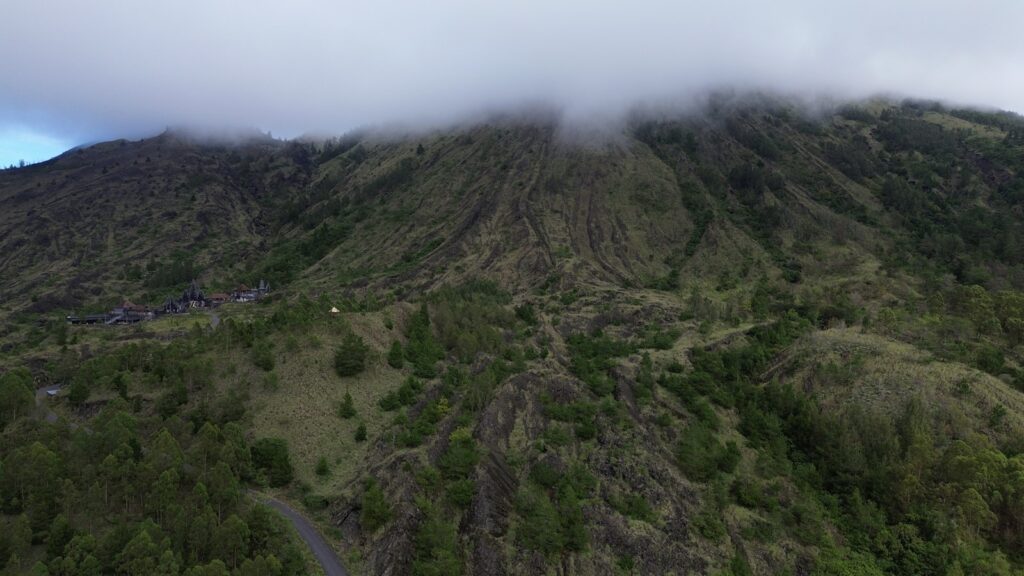
Mount Batur is a 1,717-metre active stratovolcano set inside a vast ancient caldera — the outer rim of that caldera, formed by a catastrophic eruption roughly 29,000 years ago, is what you see first as you cross the central highlands from the south. The inner cone is Batur itself. Below it, Lake Batur stretches roughly 7.5 kilometres, its surface dark at dawn and steel-blue by mid-morning. On a clear day the visual is genuinely dramatic: a black lava field on the lower flanks, the village of Toya Bungkah hugging the lakeside, and terraced hillsides falling away to the north coast.
Flying north from the South Bali heliports, you cross Ubud’s jungle canopy and rice-terrace ridges before the caldera rim appears. A dedicated 30-minute volcanic route gives you 10–12 minutes of real caldera time after transit. That is enough for one full orbit of the inner cone and a low pass over the lake — good for photos, not lingering. The 60-minute routes are substantially better: operators including Mason Adventures and Raffles Bali build in Ubud and the west coastline (Tanah Lot Temple from above, Canggu, sometimes Jatiluwih rice terraces) on the return leg. Raffles documents a 1h 06m route covering Kintamani, Batur, Lake Batur, Ubud, and Tanah Lot; their 1h 15m version adds Jatiluwih — the UNESCO-listed subak rice-terrace system — and Sanur on the coast.
If you want to add Mount Agung — Bali’s highest peak at 3,031 metres, 25 kilometres east of Batur — expect a grand tour of at least 85–100 minutes. The Raffles 1h 25m “Grand Tour” threads Agung into its route alongside Batur, Ubud, and a Nusa Penida pass on the way back to Jimbaran. That is a very different product from the standard caldera flight, and the price reflects it.
Mount Batur Helicopter Tour Price: Per-Seat vs Private Charter
Two pricing models exist across Bali operators and they serve different travellers. Here is an honest breakdown based on published rates and verified market brackets.
Per-Seat Shared Scenic Pricing (Approximate IDR & USD)
| Route / Duration | What You See | Per Seat (IDR) | Per Seat (USD approx.) |
|---|---|---|---|
| Batur Volcano Only — ~30 min | Mt Batur caldera, Lake Batur, lava field | IDR 7,500,000–10,990,000 | USD 470–690 |
| Volcano & Coastline — ~55–60 min | Batur + Ubud + Tanah Lot + west coast | IDR 10,990,000–14,990,000 | USD 675–950 |
| Grand Volcano + Islands — ~75–85 min | Batur + Agung + Nusa Penida pass | IDR 14,990,000–16,990,000 | USD 950–1,080 |
Source: Balicopter published seat pricing; Raffles Bali 2026 brochure; Mason Adventures route data. IDR/USD conversion at approximately 15,500–16,000 IDR per USD — verify current rate at booking. Shared-seat pricing assumes a 2–4 passenger minimum fill; confirm whether the operator will fly with one or two passengers or requires an aircraft buyout.
Private Charter Pricing (Whole Aircraft)
A private charter means you buy the entire helicopter — pilot and up to 4–5 passenger seats are yours. For groups of three or more, the per-person cost of a private charter often comes within 20–30 percent of shared-seat pricing, with the significant advantages of a flexible route, no strangers, and the ability to circle a landmark a second time if the shot was not right.
| Duration | Private Charter (IDR) | Private Charter (USD approx.) | Notes |
|---|---|---|---|
| ~30 min caldera-focused | IDR 28,000,000–35,000,000 | USD 1,750–2,200 | Inferred from operator hourly rates; confirm directly |
| ~60 min Batur + Tanah Lot | IDR 38,000,000–46,000,000 | USD 2,400–2,900 | Aligns with published 42–55 min private brackets |
| ~75–85 min grand tour | IDR 55,000,000–66,000,000 | USD 3,500–4,200 | Published Raffles 1h–1h25m tier |
The 30-minute private figure is interpolated from the market — no operator publishes it as a standalone rate. Treat it as an orientation number, not a binding quote. Always ask the operator for their current IDR price sheet before comparing.
The Effective Hourly Rate Problem
This matters for Batur specifically. Because the volcano is 35–45 km inland, a 30-minute booking is genuinely a short charter: you are flying transit time plus caldera time on one block. Operators price this as a product, not a fraction of the hourly rate, which is why the per-minute cost on a 30-minute Batur route is higher than on a 45-minute Nusa Penida flight where you are over the destination almost immediately after departure. If the numbers look odd, that is why. The 60-minute volcano-and-coastline route delivers meaningfully better value per minute of scenery.
Ready to check availability for your dates? Plan your trip with our concierge — share your group size and preferred dates and we will pull current operator pricing for you. WhatsApp planning also works well for groups comparing the 30 vs 60-minute options.
Best Time to Fly: Why Morning Matters More for Batur Than Anywhere Else
Of all the Bali helicopter routes, Kintamani and the caldera are the most time-sensitive. The reason is thermodynamics, not tourism marketing. By late morning — typically 09:30–10:30 WITA — the dark lava field on Batur’s flanks absorbs heat faster than the surrounding caldera rim and lake surface. That contrast generates convective lift, which in practical terms means turbulence that builds through the afternoon and cumulus cloud that forms over the cone itself. Many operators have experienced flights where the caldera was crystal clear at 07:00 and was sitting in its own weather cell by 11:00.
Target departure time: 06:30–08:30 WITA from the helipad. That places you over the caldera in the golden-hour light that turns Lake Batur from grey to amber. It also maximises the chance of a clear view down into the inner cone rather than looking at cloud tops. Sunrise-timed Batur flights are one of the few helicopter products in Bali where the photography motivation aligns perfectly with the safety-of-flight motivation.
Operator standard hours are typically 10:00–16:30, but premium operators and private charters can often arrange early-morning departures with advance notice — ask specifically when enquiring. Dawn Batur flights are not widely advertised because they require pre-dawn ground transport from your hotel (60–90 minutes from South Bali to the Ungasan helipad area), but the difference in visibility and light quality is substantial.
Dry Season vs Wet Season for a Kintamani Helicopter Scenic Flight
Bali’s dry season runs approximately April through October. These are the most reliable months for clear caldera views: lower cloud bases, less afternoon convective activity, and far fewer same-day cancellations. July and August are peak tourism months — book the Batur route at least two weeks in advance for a shared flight, longer for a private charter on a preferred date.
The wet season (roughly November through March) does not make Batur flights impossible — clear mornings do occur, particularly in November and early December before the wet season intensifies. But afternoon thunderstorms are common and can extend into the morning hours. Cancellation rates rise, and the caldera cloud cover is frequently 3–4 oktas by mid-morning even when the south coast is clear. If Batur is a priority and you are travelling between December and February, build a same-day rebooking buffer into your itinerary rather than counting on a specific date.
All scenic flights in Bali operate under VFR (visual flight rules) — they cannot legally depart when visibility drops below the required minimums. Reputable operators cancel and reschedule or refund when the conditions do not meet those standards. Confirm the operator’s weather-cancellation policy before booking: the industry norm is a full credit or reschedule at no penalty; a no-refund-under-any-weather policy is a red flag.
Safety Notes: Active Agung, Turbulence & the Batur Route
Mount Agung’s eruption cycle is well-documented — the 2017–2019 activity closed Ngurah Rai airport twice and affected airspace across eastern Bali. When Agung is in an elevated-alert phase (PVMBG levels III or IV), operators restrict or suspend eastern routes and any routing that passes through the volcanic ash advisory zones published by the Darwin VAAC. Batur itself (a separate volcanic system to the southwest) does not typically trigger the same airspace restrictions, but any eruption at Agung affects flight planning across the island.
Check the current Agung alert level via PVMBG (Pusat Vulkanologi dan Mitigasi Bencana Geologi) before booking a grand tour that includes Agung. Reputable operators monitor this daily; they will tell you if the Agung section of a route is currently available. Do not book an “includes Agung” tour and assume it will fly as described — confirm it explicitly at the time of reservation.
Turbulence on the Batur route is real but manageable in the right window. The most significant source is mechanical turbulence off the caldera rim in the afternoon, and the thermal activity over the lava field mentioned above. Early morning — the same timing that gives you the best views — is also the smoothest air window. If you or a travelling companion experience motion sickness on road or boat journeys, morning timing is not optional; it is the practical mitigation.
Aircraft, Capacity & Weight for Batur-Bound Flights
The most common aircraft on Bali scenic routes are the Bell 505 Jet Ranger X (one pilot, up to four passengers) and the Robinson R66 (one pilot, up to four passengers). The R66 is the lighter, more economical turbine single; the Bell 505 carries a Garmin glass cockpit, Bose headsets, and has a slightly larger cabin. For longer routes like the 75-minute grand tours, operators tend to deploy the Bell 505 or similar for comfort over distance.
Weight limits matter on any helicopter, but they matter more on routes that require sustained high-altitude flight over the caldera at 1,700+ metres MSL. The density altitude at Batur is not extreme, but it does reduce effective payload compared to sea-level South Bali operations. Expect operators to enforce a per-passenger weight declaration at booking — typically a soft limit around 100–120 kg per person — and to conduct an actual weigh-in or weight confirmation at check-in. Fly Bali’s publicly stated policy caps total payload (passengers plus luggage) at 350 kg; other operators quote 320 kg. If your group is heavier, the operator may reduce fuel load (affecting range), add a smaller intermediate stop, or in some cases reschedule to a different aircraft. Do not surprise the operator at the helipad — declare weights accurately at the time of booking.
Luggage is essentially not possible on a Batur scenic flight. A small personal camera bag or day pack per person is fine. Hard cases and rolling luggage do not fit. This is a scenic route, not a transfer — plan accordingly.
How the Batur Route Compares to Ubud and Tanah Lot
There is significant overlap between the Batur route and the Ubud/Tanah Lot routes at the 60-minute tier. In practice, many operators treat these as one product: the “volcano and west coast” or “volcano and temples” flight covers Batur caldera, Ubud jungle and rice terraces (sometimes Tegallalang), and Tanah Lot on the coastal return. If that is the itinerary you want, read our Ubud helicopter tour price guide and our Tanah Lot route breakdown alongside this page — the price structures are closely related and operators often price the combined 60-minute product as a single SKU.
The Batur-only 30-minute product is distinct: it is purely a volcano and caldera flight with no coastal content. It suits travellers who have already done the south coast and Ubud routes and want the highlands specifically — or those whose schedule only allows a shorter flight. For first-time Bali helicopter passengers, the 60-minute Batur-plus-coastline option gives you a much wider cross-section of what the island looks like from altitude, and the per-minute cost works out better.
For a broader context on how all these routes compare on price, see our master Bali helicopter price guide and our sunrise vs sunset flight comparison — the timing analysis there is directly relevant to how you should schedule a Batur flight.
Comparing the 30-minute and 60-minute options for your specific group size? Reach our concierge for a current price check — we can also advise on which operators run early-morning volcano departures and whether your travel dates fall in peak season pricing. WhatsApp is the fastest channel if you are already in Bali.
Frequently Asked Questions
How much does a Mount Batur volcano helicopter tour cost in Bali?
A shared per-seat ticket on a Batur-focused scenic flight runs approximately IDR 10,990,000–14,990,000 per person (roughly USD 675–950) for the 55–60 minute volcano-and-coastline product. A standalone 30-minute caldera flight is less common but where offered runs around IDR 7,500,000–10,990,000 per seat. Private charter of the whole aircraft for 60 minutes costs approximately IDR 38,000,000–46,000,000 (USD 2,400–2,900). Always confirm the current IDR rate directly — these figures reflect 2025–2026 market data and operators adjust for season and FX.
Is the Mount Batur helicopter tour safe when Mount Agung is active?
Batur and Agung are separate volcanic systems roughly 25 kilometres apart. A Batur-only caldera flight is generally not affected by Agung’s alert status unless ash advisories restrict the wider Bali airspace. However, grand tour routes that specifically fly over or near Agung are suspended during elevated alert phases (PVMBG levels III–IV). Check the current Agung status and confirm with your operator whether the specific route you are booking includes an Agung overflight, because some “volcano tour” products do and others do not.
What is the best time of day to fly a helicopter over Mount Batur?
Early morning, ideally departing the helipad between 06:30 and 08:30 WITA. By late morning, thermal activity over the dark lava field generates turbulence and cumulus cloud that can obscure the inner cone. An early departure also catches the best photography light on the lake and caldera rim. Standard operator hours start at 10:00, but private charters can often arrange pre-dawn departures with advance notice — worth asking if the view is a priority for you.
Can I do a 15-minute Batur helicopter flight?
No. Batur is roughly 35–45 kilometres inland from the South Bali helipad bases near Ungasan and Jimbaran. Transit time alone accounts for 15–20 minutes each way. A 15-minute booking would not get you to the caldera and back. The realistic minimum for any meaningful Batur experience is 30 minutes — which gives you 10–12 minutes of caldera time — and the 55–60 minute volcano-and-coastline route is what most operators actually sell as the standard Batur product.
Does the bali volcano and coastline helicopter tour include Tanah Lot?
On most 60-minute-plus routes, yes. The typical itinerary threads Batur and Lake Batur on the outbound leg, then follows the west coastline south on the return, passing Tanah Lot temple from above before landing back at the South Bali helipad. Some routes also include Ubud rice terraces or Jatiluwih (UNESCO subak terraces) on the transit between the coast and the volcano. Confirm the exact waypoints with your operator at the time of booking, as route inclusions vary by aircraft availability and wind conditions on the day.