How we stay independent: Bali Helicopter Price is not an operator and earns no commission on the prices shown. If you use our free booking help, we may receive a referral fee from the operator at no extra cost to you. It never changes the figures we publish.
An uluwatu helicopter tour bali price starts around IDR 1,990,000 per seat (roughly USD 125–140) for the shortest shared scenic circuit, and climbs to IDR 25–26 million per helicopter for a private 15-minute flight. Those numbers look far apart, but the gap collapses fast once you understand what each buys—and what the operators quietly leave out of their “from” figures.
This guide covers the south Bukit coastline route only: GWK Garuda Wisnu Kencana statue, Melasti and Pandawa beaches, the Uluwatu Temple promontory, and Nyang Nyang Beach. It does not conflate this route with Nusa Penida, Mount Batur, or Ubud—landmarks that are simply unreachable in a 10–15 minute flight from any South Bali helipad. If someone quoted you a “Nusa Penida with Uluwatu” tour for under 20 minutes, they were wrong about the distances.
The Route: What a South Bali Helicopter Actually Covers
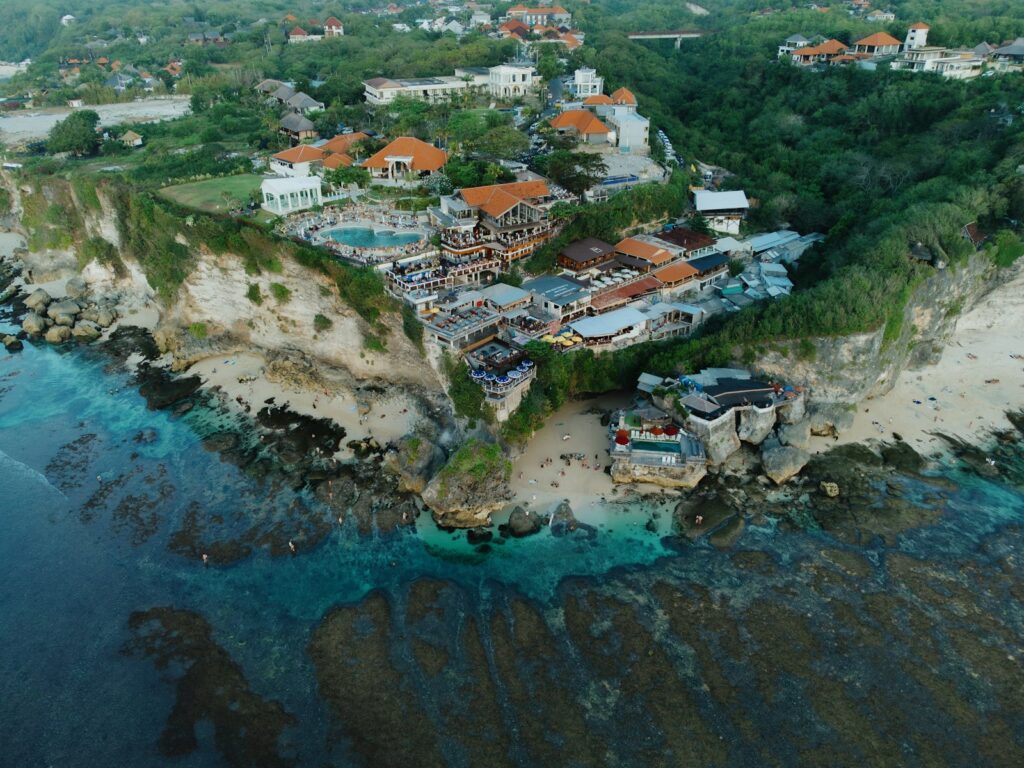
The Bukit Peninsula is a raised limestone plateau hanging off the southern tip of Bali. From the air it looks unlike anywhere else on the island—bleached cliffs dropping sixty metres straight into turquoise water, surf breaking white across reef shelves, temple walls appearing to float on the headland. The peninsula is compact enough that a short flight sees it end to end.
10-Minute “South Bukit Taster” (GWK, Melasti, Pandawa)
Departing from the Ungasan heliport or the Raffles Jimbaran helipad, a 10-minute scenic circuit typically crosses three landmarks in this order:
- GWK (Garuda Wisnu Kencana) — The 121-metre Vishnu-and-Garuda statue seen from above is one of the genuinely striking aerial images in Bali. You get the sculpture in context: the limestone amphitheatre, the cultural park, Jimbaran Bay curling to the north.
- Melasti Beach — A steep-access white-sand beach wedged between cliffs. Accessed by only one winding road from land, from the air you see why it stays less crowded.
- Pandawa Beach — The “secret beach” carved from the cliff wall, five Hindu deity statues visible in the rock face. Then a turn and the return leg.
Uluwatu Temple does not appear on a 10-minute circuit. The flight path turns back before reaching the southwest tip of the peninsula. Operators market this honestly as a coastline or “taster” product—it is what it is, a short sharp visual hit, not the full south-coast sweep.
15-Minute “Uluwatu Skyline” (GWK to Temple to Nyang Nyang)
Adding five minutes purchases the route extension southwest: past Padang Padang, past the surf breaks at Bingin and Dreamland visible as white ribbon below, all the way to Uluwatu Temple on its clifftop—and, if the pilot continues on the return arc, Nyang Nyang Beach, one of the most isolated stretches of sand on the Bukit.
This is the realistic ceiling for a 15-minute south Bali flight. The Uluwatu Temple photograph—that Insta-famous overhead of the pura perched on a sheer limestone edge with ocean on three sides—is taken on this route. Sunset timing matters here: the southwest-facing cliffs catch the last light directly, and temple shadows stretch long across the headland in the final 45 minutes before dusk.
What Is NOT on This Route
Be clear-eyed about geography. From any South Bali departure point:
- Nusa Penida is roughly 20–25 kilometres across open water. A helicopter cruising at 220 km/h takes 15–20 minutes just to reach Kelingking Beach—with nothing left for sightseeing. The Nusa Penida scenic route realistically needs 42–55 minutes total.
- Mount Batur / Kintamani is 50–60 km north through varying terrain. A genuine volcano circuit from South Bali requires 60–75 minutes.
- Ubud and Tegallalang rice terraces are 35–40 km north. They appear as part of extended “grand tour” routes of 60 minutes or more, not south coast packages.
Any operator pitching those destinations on a 15-minute south-coast product is either misrepresenting the route or conflating different products. Confirm the actual flight path before booking.
Uluwatu Helicopter Tour Price Brackets: 10 and 15 Minutes
Two purchasing models exist across the Bali helicopter market. Per-seat shared scenic flights (you book your own seat on a fixed scheduled circuit) versus per-helicopter private charters (you buy the whole aircraft for your group). Both serve the same route—the economics are very different.
Per-Seat Shared Scenic Flight Prices
| Duration | Route highlights | IDR / seat (from) | USD approx. / seat |
|---|---|---|---|
| 10 min | GWK – Melasti – Pandawa | IDR 1,990,000–2,290,000 | USD 125–155 |
| 15 min | GWK – Melasti – Pandawa – Uluwatu Temple – Nyang Nyang | IDR 3,390,000–3,800,000 | USD 215–250 |
These are Balicopter’s published figures (the most transparent operator in this market). Other operators either match closely or price slightly higher; none publish significantly lower for the same route. The USD conversion assumes IDR 15,000–16,000 per dollar—which moves with the currency. Always confirm IDR pricing with the operator.
Per-Helicopter Private Charter Prices
| Duration | IDR / flight (approx.) | USD approx. / flight | Per-person if 4 pax |
|---|---|---|---|
| 10 min | IDR 22,000,000–23,000,000 | USD 1,400–1,500 | USD 350–375 |
| 15 min | IDR 25,000,000–27,000,000 | USD 1,600–1,800 | USD 400–450 |
Private 10-minute charter pricing is grounded in the Raffles Bali brochure rates (IDR 22.44M published for a 10-min private flight). The effective hourly rate on that 10-minute block works out to roughly USD 8,000–9,000 per flight-hour—which sounds alarming until you remember that minimum block-time pricing is standard in aviation globally. You’re paying for aircraft availability and crew time, not just airborne minutes.
When Private Charter Breaks Even vs. Per-Seat
The math is straightforward. On a 15-minute circuit, a per-seat ticket runs roughly USD 215–250. A private helicopter holds 4–5 passengers and costs approximately USD 1,600–1,800 total. Divide that across four people and you pay USD 400–450 each—about 70–80% more per person than a shared seat. Private only reaches per-seat parity if you have five passengers, and even then you’re paying a small premium for exclusivity and scheduling flexibility. For a couple, shared is the clear value option. For a family of five, private is worth the small uplift.
Hidden Costs That Inflate the Final Bill
The “from” prices operators quote publicly are rarely the number you pay. Watch for these:
- Tax
- Indonesian VAT (PPN) is 11%. Some operators quote net-of-tax (“nett”), others add it at checkout. Raffles Bali brochure language suggests tax-inclusive pricing; standalone operators vary. Ask explicitly: “Is this the price I pay or does tax apply?”
- Heliport fee
- The Ungasan heliport (Fly Bali’s base, Jl. Pantai Melasti no. 8) is a registered facility. Some operators pass the heliport landing/handling fee through separately. Confirm this is bundled.
- Hotel transfer
- Ground transport to/from the helipad is sometimes included (BaliLook advertises free ground transfers from Nusa Dua, Uluwatu, Ungasan, and Jimbaran) and sometimes charged as an add-on. If you are staying in Seminyak or Canggu, the 45–60 minute drive to Ungasan is an inconvenience worth factoring in.
- Minimum passenger rules on “shared” flights
- Some operators require 2–4 passengers to operate a shared departure. Book solo and you may be quietly sold a partial-charter at a higher per-person rate. Clarify whether a single-seat purchase guarantees a seat or a departure contingent on filling the aircraft.
- Weight surcharge
- Fly Bali enforces a total payload cap (passengers plus luggage). BaliLook states 320 kg maximum. A heavier passenger—typically above 100–120 kg—may incur an additional charge or require a seat rebalance. Declare honestly at booking rather than at the helipad.
Ready to lock in a south Bukit flight without guesswork? Plan your trip with our concierge—we verify operator pricing, tax status, and helipad access for your hotel before you commit. WhatsApp planning available if that is faster for you.
Departure Points: Ungasan Heliport and Jimbaran
Virtually all commercial south Bali helicopter operations depart from one of two locations on the Bukit Peninsula.
Ungasan Heliport (Fly Bali Base)
Located at Jl. Pantai Melasti no. 8, Ungasan, Kuta Selatan—coordinates approximately 8°50’S, 115°09’E—this is described by the operator as the only registered heliport in South Bali under Indonesia’s Ministry of Transportation regulation PM 94/2015 (verify current DGCA status, as regulatory environments evolve). It sits roughly 1.5 nautical miles from GWK and 5.5 nautical miles from Ngurah Rai airport. The Alila Uluwatu, Bulgari, Banyan Tree, and Ayana resorts are nearby. If your hotel is in Nusa Dua or Jimbaran, ground time to the heliport is 15–25 minutes depending on traffic.
Raffles Bali / Jimbaran Helipad
Raffles Bali operates an active hotel-based helipad in Jimbaran used for their documented scenic route portfolio. This is a private helipad—not a public heliport—so access is typically through Raffles directly, either as a hotel guest or via a booked flight package. The GWK helipad in Pecatu is similarly used for short hops and transfers between cliff-top resort properties.
For guests staying in Seminyak, Kerobokan, or Canggu: no commercial helipad operates in the north Kuta corridor. The Ungasan or Jimbaran departure is a genuine 40–60 minute drive from those areas, which should factor into sunset timing calculations.
Sunset Timing: When to Book the Uluwatu Helicopter Ride
Bali sits close to the equator—8 degrees south—which means sunset times are relatively stable year-round, ranging from about 17:55 in June to 18:30 in December. The southwest-facing Uluwatu cliffs are directly in the sunset sightline. This matters because helicopter platforms are typically available 10:00–16:30 daily (BaliLook’s published operating window; other operators run similar hours). That leaves a gap between the standard close-of-operations and the premium golden-hour window.
A small number of operators offer specifically timed sunset scenic circuits—check availability carefully and book 1–2 weeks ahead in peak season (July–August and Christmas/New Year). The light is best 30–45 minutes before actual sunset: the cliffs glow ochre, the temple shadows are long, and contrast between the white water and blue sea is maximum. A midday departure produces washed-out colours and harsh shadows—technically fine for seeing the terrain, less special as a photo experience.
Dry season (April–October) gives better odds of clear skies. The rainy season (November–March) brings afternoon convective cloud that can ground or truncate short circuits. Reputable operators make go/no-go calls on the day and reschedule or refund; confirm their weather-cancellation policy in writing before you pay a deposit.
Curious about sunrise versus sunset for aerial photography specifically? We have a full breakdown on the sunrise vs. sunset helicopter tour page. For a complete cost overview of every Bali route from 10 to 100 minutes, the master helicopter price guide is the place to start.
What You Actually Photograph on the Uluwatu Circuit
Pilots on this route typically allow passengers to have the window seat that faces the coastline on the outbound leg (southwest sweep toward Uluwatu) and then rotate on the return. On a Bell 505 or AS350, all passenger seats have windows but the forward-facing seats get the cleanest forward-horizon shots. A 24–35mm equivalent lens handles the wide landscape; a 70–100mm pulls the temple closer. Phones with optical zoom modes work well in good light.
Key photographic moments in order:
- GWK overhead — Vertical or steep-angle down at the statue. Hard to get from the ground; from 200 metres above it is the composition nobody expects.
- Melasti cliffline — The beach itself is small and white against dark cliffs. Best angle is slightly oblique rather than directly overhead.
- Uluwatu Temple on the headland — The classic shot. The temple wall is continuous with the cliff edge; the composition works from multiple approach angles. Morning light hits the east face; sunset light hits the west face directly.
- Nyang Nyang Beach — Long, nearly empty, accessible only by a 300-step cliff path from land. From the air you understand why. Foreground surf, mid-ground white sand, cliffs framing either side.
For serious aerial photography or video content, the standard 15-minute scenic does not give enough orbiting time. A doors-off photography charter over this route starts at 30–60 minutes and requires pre-arrangement—confirm harness requirements, gear weight limits, and whether the aircraft and route are approved for doors-off operations before booking.
South Bukit vs. Longer Routes: Is 15 Minutes Enough?
That question is worth sitting with. A 15-minute Bukit circuit is a genuine experience of one of Bali’s most distinctive coastlines. It is not a comprehensive “see all of Bali” flight. If your main motivation is Nusa Penida’s Kelingking cliff or Mount Batur’s caldera, you are on the wrong route page—those require 45–60 minutes and a different price bracket entirely.
Where the short south-coast flight makes strong sense:
- You are already staying on the Bukit, in Jimbaran or Nusa Dua, and want to see it from above as a pre-dinner experience
- You are proposing, and Uluwatu Temple in the background is the specific visual you want
- You have a tight budget and want to understand what helicopter access looks like before committing to a longer charter
- You are a photographer who has already done ground-level Uluwatu and wants the aerial perspective specifically
For a full route-by-duration comparison, the cost-by-route breakdown covers every published circuit from 10 minutes to 100. If you are deciding between departure helipads, the helipad locations guide maps every known South Bali departure point.
Have questions about a specific flight or need operator recommendations for the south coast route? Contact our planning team—or drop us a message on WhatsApp and we will come back with operator-verified pricing within a few hours.
Frequently Asked Questions
How much does the Uluwatu helicopter tour cost per person in 2026?
Per-seat shared tickets on the 15-minute south Bukit coast circuit (GWK to Uluwatu Temple) are published from around IDR 3,390,000 to IDR 3,800,000 per person—approximately USD 215–250 at current exchange rates. A full private helicopter charter for the same 15-minute route costs roughly IDR 25,000,000–27,000,000 per flight (USD 1,600–1,800), split across however many passengers you have. These figures are based on Balicopter’s published rates and Raffles Bali’s brochure pricing; confirm directly with operators as rates adjust seasonally and with promotions.
Can I see Uluwatu Temple from the helicopter?
Yes, but only on the 15-minute route or longer. The 10-minute “south coast taster” covers GWK, Melasti, and Pandawa but turns back before reaching the Uluwatu Temple promontory. The temple—perched on a sheer clifftop above the ocean—appears on the 15-minute “Uluwatu Skyline” circuit, which extends the flight southwest to the tip of the peninsula. Confirm with your operator exactly which landmarks are included in the product you are booking.
Does the Uluwatu helicopter tour also fly over Nusa Penida?
No. Nusa Penida is roughly 20–25 kilometres across open water from South Bali. Flying there, seeing Kelingking, Broken Beach, and Manta Point, then returning takes 42–55 minutes minimum—at a significantly higher price (from around USD 550–600 per seat shared, or USD 2,400–3,000 for a private charter). The south Bukit coast route and the Nusa Penida route are entirely separate products. If an operator quoted you both in 15 minutes, verify the itinerary carefully.
Where do helicopters depart for the Uluwatu tour?
The primary departure point in South Bali is the Ungasan Heliport (Fly Bali, Jl. Pantai Melasti no. 8, Ungasan), approximately 1.5 nautical miles from GWK. Raffles Bali operates departures from its Jimbaran helipad. Both are on the Bukit Peninsula. Ground transfer time from Seminyak is roughly 45–60 minutes; from Nusa Dua or Jimbaran hotels, 15–25 minutes. Some operators include a ground transfer in the package—confirm at booking.
What is the best time for a sunset helicopter ride over Uluwatu?
Uluwatu’s southwest-facing cliffs catch direct sunset light, making a late-afternoon flight the most photogenic option. Bali sunsets fall between roughly 17:55 and 18:30 year-round. Most operators run scheduled hours up to about 16:30, so a true last-light departure requires booking a specifically timed sunset circuit—not all operators offer this as a standard product. Book 1–2 weeks ahead in peak season (July–August, Christmas, school holidays) and confirm the weather-cancellation policy before paying a deposit. Dry season (April–October) gives the most reliable conditions.