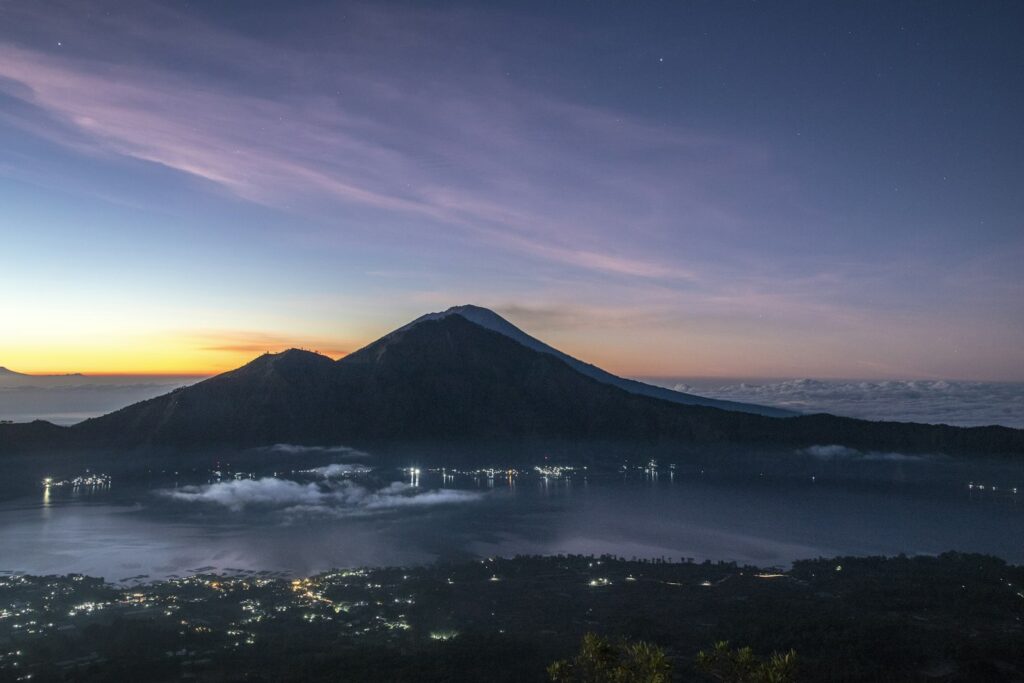
A Bali volcano sunrise helicopter tour is a flight timed to reach the Mount Batur caldera at or just after first light — and the cost runs roughly IDR 10,990,000–16,990,000 per seat on a shared scenic flight (approximately USD 675–1,060) or IDR 38,000,000–66,000,000 for a private charter of the whole aircraft, depending on duration and how much of the island you add to the return leg. Sunrise timing is not a marketing gimmick here. It is the single biggest factor in whether you see a crisp caldera or a cone buried in its own cloud. This guide covers why the early window matters more at Batur than anywhere else in Bali, what departure time actually gets you there at the right moment, how much extra the pre-dawn logistics cost, and what current pricing looks like across the market.
Why Sunrise Changes Everything at Mount Batur
Mount Batur sits at 1,717 metres above sea level, ringed by the ancient outer caldera of a much larger volcano that collapsed roughly 29,000 years ago. The inner cone is dark — black lava fields from the most recent eruption cycles — and that dark surface absorbs solar heat fast. By 09:30 to 10:30 WITA most mornings, that differential heating sets off convective activity: air rising sharply off the lava field, turbulence building along the caldera rim, and cumulus cloud forming directly over the cone.
The window between 06:00 and 08:30 WITA is a different atmosphere entirely. The lava field is still cool from overnight. Lake Batur — which stretches roughly 7.5 kilometres below the caldera rim — sits flat and calm, shifting from near-black to amber as the sun clears the eastern ridge. The air is smooth. The inner cone is exposed. Pilots who fly the Kintamani route regularly will tell you the same thing: the caldera at 07:15 looks nothing like the caldera at 11:00. One is a clear-air view into a geologically active crater over a lake that looks like hammered bronze. The other is often just a cloud top.
The thermal argument also has a direct bearing on motion sickness. If you or a travelling companion is sensitive to turbulence, morning is not just aesthetically better — it is practically calmer. The afternoon mechanical and convective turbulence off the rim is real. Early morning eliminates most of it.
Target Departure Time: How the Numbers Work
The South Bali helipads — the Fly Bali Heliport at Jl. Pantai Melasti no. 8 in Ungasan (roughly 5.5 nautical miles from Ngurah Rai), and the Raffles Bali helipad in Jimbaran — are roughly 35–45 kilometres from Batur by air route. At a light single’s cruising speed of around 220 km/h, that transit takes approximately 12–18 minutes each way. Add a few minutes of climb and descent. For a 30-minute caldera-focused flight, you get 10–12 minutes of actual time over the volcano and lake.
Work backwards from when you want to be over the caldera. Ideal caldera time: 06:45–08:00 WITA, when the light is low-angle and warm and the convective cycle has not started. That means a helipad departure of approximately 06:15–06:30 WITA. Sunrise in Bali falls between roughly 06:00 and 06:20 WITA depending on the month — earliest in June (around 06:00), latest in December (around 06:20). So a 06:30 departure from Ungasan puts you over the caldera rim as the first horizontal light is catching the eastern face of the cone. That is the shot most photographers are after.
Standard operator hours at most Bali helicopter companies run from 10:00 to 16:30 WITA. A sunrise Batur departure at 06:15 or 06:30 is outside the standard window. This is achievable on a private charter with advance arrangement — not as a walk-up booking. Budget an additional coordination lead time of at least two to four weeks, and expect the operator to confirm pilot availability for early pre-dawn operations. Some will require a small premium for off-hours departure; others include it in the charter rate. Get the confirmation in writing.
What You Actually See: The Caldera Route from South Bali
Flying north from Ungasan or Jimbaran, the first major landmark is the Ubud highland belt — terraced rice paddies, jungle canopy, the Ayung River gorge cutting south toward the coast. Then the terrain rises. The outer caldera wall appears first: a wide volcanic ridge that forms the bowl. You cross it, and suddenly the scale of the ancient eruption is visible. The inner cone — Batur itself — sits offset in the northeast quadrant of the caldera floor. The lake occupies the western half.
A 30-minute focused route gives you time to orbit the inner cone once and make a low pass over Lake Batur before the transit south. On a 60-minute route, operators such as Mason Adventures and Raffles Bali extend the return leg to include the west coastline — Tanah Lot Temple from above, the Canggu stretch, sometimes the Jatiluwih UNESCO rice terraces if the route angles north before heading down. The Raffles 1h06m documented route threads Kintamani, Batur, Lake Batur, Ubud jungle, and Tanah Lot. Their 1h15m variant adds Jatiluwih and Sanur beach on the return sweep.
At sunrise, that transit south has its own reward. The Ubud rice terraces catch the morning light differently than at midday — the terraces are still damp, the morning mist has not fully burned off the river gorge, and the colour is a specific bright green that photographers have chased down there for decades. A sunrise charter that combines Batur caldera with the Ubud highlands on the return is genuinely two different landscape experiences in one flight.
Ready to plan your sunrise window? Reach our concierge and we can check which operators currently run pre-dawn Batur departures and what lead time and pricing looks like for your dates. WhatsApp works well for back-and-forth on timing questions.
Bali Volcano Helicopter Tour Sunrise Cost: Honest Price Brackets
Two pricing models apply — per-seat shared and per-aircraft private. For a sunrise-timed flight, the relevant model is almost always private charter: standard shared flights start at 10:00 WITA, and there is no sunrise shared-seat schedule on the market as of 2025–2026. If you want first light over Batur, you are booking the whole aircraft.
Private Charter Price Ranges for Batur Routes
| Duration | Route Coverage | Private Charter (IDR) | Private Charter (USD approx.) | Notes |
|---|---|---|---|---|
| ~30 min | Batur caldera + Lake Batur only | IDR 28,000,000–35,000,000 | USD 1,750–2,200 | Inferred from hourly rates; no operator publishes this as a standalone product — confirm directly |
| ~60 min | Batur + Ubud + Tanah Lot / west coast | IDR 38,000,000–46,000,000 | USD 2,400–2,900 | Published bracket range; Raffles Bali 2026 brochure and Mason Adventures |
| ~75–85 min | Batur + Mt Agung + Nusa Penida pass | IDR 55,000,000–66,000,000 | USD 3,500–4,200 | Grand tour tier; Raffles 1h25m documented route |
All figures are whole-aircraft prices for up to 4–5 passengers depending on aircraft type. IDR/USD conversion at approximately IDR 15,500–16,000 per USD — verify current rate at booking. Confirm whether 11% Indonesian VAT (PPN) is included or added to the quoted price; operators vary. An off-hours pre-dawn departure may carry an additional coordination fee — ask at the time of enquiry.
Per-Seat Shared Pricing (Standard Hours, Not Sunrise-Timed)
If you cannot arrange or afford a dawn charter, the shared-seat volcano routes during standard hours still deliver the caldera experience — just at 10:00 or later, when conditions are less predictable. For reference:
- Volcano + coastline ~55–60 min shared seat
- IDR 10,990,000–14,990,000 per person (approx. USD 675–950). This is the standard Batur-plus-coastline product; Balicopter’s published range is IDR 14,990,000 for the 75-minute “Bali Volcanoes & Temples” seat.
- Grand tour ~75–85 min shared seat
- IDR 14,990,000–16,990,000 per person (approx. USD 950–1,080). Combines volcano and island content on a longer circuit.
The 30-minute caldera-only product exists in the market (Mason Adventures documents it) but is rarely the most economical option as a shared seat given the transit costs built into the price. The 55–60 minute route is typically better value per minute of scenery seen.
Group Size and the Private-vs-Shared Break-Even
For sunrise timing specifically, the calculation is straightforward: it is a private charter regardless of group size. But it is worth noting what the numbers look like for groups of three or more on a standard-hours shared comparison. A group of four paying per-seat on a 60-minute route at IDR 14,990,000 per person pays IDR 59,960,000 combined — which is within the upper end of a private 60-minute charter at IDR 38–46 million. Four people buying seats independently may actually pay more than the private charter price. If your group is three or larger, ask for the private charter rate before committing to individual seat bookings.
Effective Hourly Rate: Why Batur Costs More Per Minute Than Uluwatu
One thing I flag consistently in cost guides is the effective hourly rate, because it explains apparent pricing anomalies. A 10-minute South Bali coast flight at IDR 22.4 million private works out to roughly USD 8,000+ per flight-hour in effective terms. That sounds extreme, but it reflects minimum block time — the fixed operating costs of putting a helicopter in the air do not scale down proportionally for a short flight. A 10-minute booking still requires the same pre-flight check, the same fuel burn to taxi and hover, the same pilot hours.
The Batur route carries its own version of this. Because the caldera is 35–45 kilometres inland, roughly 12–18 minutes of transit each way is baked into every Batur flight regardless of duration. A 30-minute Batur booking has perhaps 8–12 minutes of actual caldera time after accounting for both-way transit and altitude gain. You are not buying 30 minutes over the volcano; you are buying a round trip to the volcano with a brief window at the destination. The 60-minute route almost doubles your caldera-plus-highland time for a price increase of roughly 30–35 percent. The arithmetic strongly favours the longer product.
Visibility and Turbulence Notes by Month
Bali’s dry season runs approximately April through October. These months offer the most reliable clear-air mornings over the caldera. June and July specifically have some of the earliest sunrises and the sharpest pre-dawn visibility. August is peak tourism — the caldera is no less beautiful but booking lead times double.
The wet season (roughly November through March) is more complicated. Clear mornings do occur, especially in November before the wet season peaks. January and February typically bring the heaviest overnight rain and the most persistent low cloud over the highland caldera — a sunrise Batur departure in those months has a meaningful same-day cancellation risk. If the wet season is your only window, build a backup date into your itinerary explicitly. Reputable operators will reschedule or refund when VFR conditions are not met; confirm their policy in writing before paying any deposit.
One specific December note: Bali’s dry-season trade winds reverse in late October or November. The transition period can produce gusty orographic conditions over the Kintamani ridge that are uncomfortable even in the morning window. Mid-December through late January is typically the most challenging month combination for clear Batur flights. That said, there are clear mornings even in February — the island does not switch to uniform grey for five months. Flying a weather-dependent product just requires a flexible mindset and an operator whose cancellation policy protects you.
Mount Agung: The Other Volcano, the Bigger Variable
Batur and Agung are separate volcanic systems. Batur sits in the northwest of the caldera; Agung — Bali’s highest peak at 3,031 metres — is 25 kilometres to the east. A standard Batur sunrise flight does not overfly Agung and is generally not affected by Agung’s alert status unless ash advisories restrict wider Bali airspace.
But the grand-tour routes — particularly the 75–85 minute charters that fold in an Agung overflight — are affected when PVMBG (Indonesia’s volcanology agency) raises Agung to alert level III or IV. During elevated-alert phases, operators suspend routing near the volcano and any segment that passes through volcanic ash advisory zones issued by the Darwin VAAC. Before booking any “grand volcano tour” that promises both Batur and Agung, confirm with the operator whether the Agung overflight is currently available. This is not a theoretical risk: the 2017–2019 Agung eruption cycle closed Ngurah Rai airport twice and restricted airspace across eastern Bali for extended periods.
For more on how alert levels affect specific routes and the current regulatory picture, see our full Mount Batur helicopter tour price and route guide, which covers the Agung safety considerations in depth alongside a complete route-by-route cost breakdown.
Pre-Dawn Logistics: Ground Transport, Helipad, and Lead Time
A 06:15 helipad departure from Ungasan or Jimbaran means leaving most South Bali hotels at 04:45–05:30 WITA. From Seminyak or Canggu, the road is 45–70 minutes even at that hour. Ubud-based guests face 60–90 minutes of driving on a good morning. This is real pre-dawn travel, and it matters for logistics planning — especially if you have children in the group or travelling companions who do not move easily before 05:00.
The trade-off is entirely worth it in my view. A caldera in full morning light with no cloud and smooth air is a categorically different experience from the same route at 10:30. But go in with eyes open about the ground logistics. Private car transfer to the helipad is the only realistic option at 05:00 — confirm your accommodation can arrange or recommend a driver for that hour, and add the transfer cost into your overall budget calculation.
On lead time: pre-dawn sunrise charters require more advance coordination than standard-hours bookings. The helipad team, pilot scheduling, and sometimes resort or ground-transport coordination all need to be aligned before the day. Four to six weeks of lead time is a reasonable target for a sunrise Batur charter, especially during peak months. Two to three weeks may work in shoulder season but is cutting it close.
Thinking through the dates and logistics for a sunrise Batur charter? Plan your trip with our concierge — we can pull current operator availability, compare pre-dawn charter rates, and flag the best month based on your travel window. WhatsApp questions about timing and weather windows are especially welcome; that kind of real-time exchange works better than a generic contact form.
What to Bring and What to Wear
Closed-toe shoes are non-negotiable at any Bali helipad — sandals and flip-flops are refused boarding at every operator I am aware of. This is not bureaucratic fussiness; it is a rotor-wash and hot-exhaust safety measure during boarding. Wear them.
At 1,717 metres above sea level, Batur is measurably cooler than coastal Bali — often 8–12°C cooler, which in practical terms means a light fleece or jacket is appropriate even in the dry season. If you are boarding at 06:00 for a sunrise flight, the pre-dawn coastal temperature is already a few degrees lower than daytime. Dress in layers. You can remove a layer once you are at altitude if necessary.
Camera: a modern smartphone is genuinely good enough for this flight if you are not a professional shooter. The aircraft windows on the common Bali types — Bell 505, Robinson R66 — are large and relatively clean. For dedicated photography, a mirrorless with a standard zoom works well; confirm with the operator how the strap should be secured. Avoid bringing loose accessories (lens caps, phone cases, hat without a chin strap) that can become airborne. For serious aerial photography with doors off, that is a separate product — see our doors-off photography guide — and is not a standard sunrise scenic booking.
Frequently Asked Questions
How much does a Bali volcano sunrise helicopter tour cost?
Because sunrise timing requires a private charter (no shared-seat sunrise products exist on the Bali market as of 2025–2026), you are buying the whole aircraft. A 60-minute Batur-plus-coastline private charter runs approximately IDR 38,000,000–46,000,000 (USD 2,400–2,900 at current FX), with 75–85 minute grand-tour options reaching IDR 55,000,000–66,000,000. The 30-minute caldera-only private is possible but infrequently published as a standalone rate; expect operators to quote in the IDR 28–35 million range, though you should confirm directly. Prices are quoted per aircraft, not per person — for groups of three or four, that can work out to USD 600–900 per head on the 60-minute route, which compares reasonably with per-seat shared rates for the same duration.
What time should I depart for a sunrise volcano helicopter flight in Bali?
Target a helipad departure between 06:15 and 06:30 WITA to be over the caldera rim during the best light window (roughly 06:45–08:00 WITA). Bali sunrise is around 06:00–06:20 depending on the month, so a 06:30 departure gets you to Batur as the first low-angle light is hitting the eastern caldera face. After 08:30–09:00, convective activity begins over the lava field and cloud formation accelerates. Standard operator hours start at 10:00, so a pre-dawn departure requires a private charter arranged in advance — typically four to six weeks lead time.
Is a Mount Batur helicopter tour safe with Mount Agung active?
Batur-only caldera flights are generally unaffected by Agung’s alert status — they are separate volcanic systems roughly 25 kilometres apart. Grand-tour routes that specifically include an Agung overflight are suspended during PVMBG alert levels III and IV. Before booking any tour marketed as a “two volcano” product, confirm explicitly whether Agung is currently on the active route and whether the operator holds a current go/no-go assessment. Reputable operators monitor PVMBG and Darwin VAAC ash advisories daily and will tell you straight if Agung routing is off the table.
Is it worth paying extra for sunrise timing versus a mid-morning Batur flight?
For caldera visibility and photography light, the answer is yes — unambiguously. The pre-thermal morning window gives you clear air, smooth conditions, and low-angle light on the lake and cone that simply does not exist at 10:30. The practical cost is pre-dawn ground logistics: a 04:45–05:30 hotel departure depending on your location, private car transfer, and the premium of a private charter versus a shared seat. If the Batur experience is a priority rather than just a checkbox, the extra effort and cost buy you a materially different flight. If it is one item on a multi-activity day and you are cost-constrained, the standard 10:00 flight still delivers the caldera — just with less certainty about cloud and with afternoon thermals building before you land.
How far in advance do I need to book a sunrise Batur helicopter charter?
Four to six weeks is the practical target for dry-season months (April through October). Pre-dawn departures require pilot scheduling, helipad coordination, and sometimes ground-transport arrangement outside normal operating windows — all of which need more lead time than a standard-hours booking. In wet-season months (November through March), you may find availability with less notice, but weather cancellation risk is higher and having an alternate date lined up is important. Booking a sunrise Batur charter the week you arrive in Bali is possible but not reliable, particularly in July and August when demand is at its peak.