Yes — volcano helicopter tours over Bali are routinely operated safely while Mount Agung remains volcanically active, because reputable operators never fly into an exclusion zone and every flight is conducted under Visual Flight Rules (VFR) with a real-time go/no-go decision made on the morning of departure. The key question is not whether Agung is doing something today, but whether you have booked with an operator who holds a valid Indonesian AOC 135 charter approval, whose pilot checks DGCA and PVMBG volcanic alert levels before engine start, and who will pull the plug without argument if conditions are not right.
That said, “safe” needs precise unpacking. Mount Batur and Mount Agung are two different volcanoes, about 25 km apart by air. Most visitors who book a “Bali volcano helicopter tour” are flying over Batur and its caldera lake — a well-established scenic route. Agung is the taller peak (3,142 m, Bali’s highest point) visible from a longer grand-tour flight. Whether one or both are in your route, the same flight-discipline applies. Here is what actually governs these decisions.
The Two Volcanoes, and Which One You’re Likely Flying Over
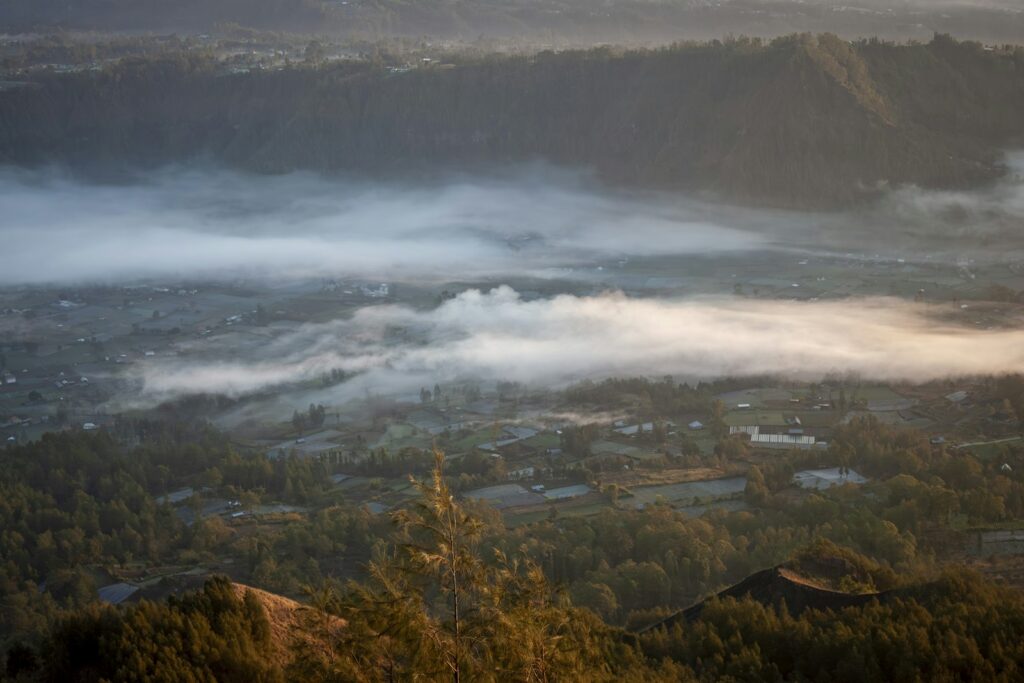
Mount Batur (1,717 m) sits in the Kintamani highlands in Bangli Regency. Its caldera is roughly 13.8 km wide, holds a crescent-shaped lake, and from the air reads as one of the most dramatic formations in Southeast Asia — a concentric ring of older caldera walls, younger cones, and dark lava flows spilling toward the lake shore. It has been the focus of most Bali “volcano helicopter tour” marketing precisely because it is scenically photogenic, relatively accessible from South Bali helipads in about 30–40 flight minutes, and sits at an altitude that does not require oxygen equipment.
Mount Agung (3,142 m) is in Karangasem, northeast Bali. It last had a major eruption in 1963–1964 and returned to significant activity in 2017–2019, producing ash columns and occasional lava flows that reached several kilometres from the summit. It currently holds a persistent Level II (Waspada / “Watch”) status under Indonesia’s PVMBG four-tier system, meaning moderate activity with a default exclusion radius that pilots must respect. A shorter flight — say, a 30-minute Batur-only circuit — would not pass over Agung at all. You typically see Agung only on routes of 60 minutes or more, such as the documented Raffles 1h25m “Grand Tour” that tracks Sanur–Ubud–Batur–Agung–Manggis–Devil’s Tears–Kelingking–Nusa Dua.
If you want to understand pricing and exact waypoints for the Batur route, our Mount Batur volcano helicopter tour guide has the full caldera circuit breakdown.
How Indonesia’s Aviation Authority Handles Volcanic Activity
Indonesia’s volcano monitoring agency, PVMBG (Pusat Vulkanologi dan Mitigasi Bencana Geologi), issues alert levels on a four-tier scale: I Normal, II Waspada, III Siaga, IV Awas. Each elevated level comes with a recommended public exclusion radius — typically 3–4 km around the summit at Level II, expanding to 6–10 km at Level III, and the surrounding aviation community issues NOTAMs (Notices to Airmen) that translate those ground exclusions into flight restrictions.
Indonesia’s civil aviation regulator, the DGCA (Direktorat Jenderal Perhubungan Udara), governs helicopter charter operators under CASR Part 91 for general flight rules and AOC 135 for on-demand commercial charter. VFR operations require minimum visibility and ceiling thresholds — an ash plume significantly visible from the air will breach those thresholds and ground the flight regardless of volcano level. NOTAM-based exclusion zones mean that even if visibility is acceptable, a pilot operating under a valid AOC cannot penetrate the published restricted airspace above an active volcanic exclusion radius.
In practice, this means a licensed Bali helicopter operator flying a route that includes an Agung overflight on a Level III day is not making a judgment call — they are legally prohibited from flying through that airspace.
What a Real Go / No-Go Decision Looks Like
Reputable operators make a flight decision hours before your scheduled departure, not on the helipad. The morning check typically includes: the latest PVMBG volcanic alert bulletin, any active NOTAMs covering your route, local weather (cloud base, wind, visibility forecast), and the pilot’s own assessment of actual conditions at the departure helipad. For mountain routes, they are also monitoring ash dispersion reports — even a technically “legal” flight corridor can be called off if sustained ash from a recent event is drifting through the planned altitude band.
There is a legitimate question about whether every operator runs this check to the same standard. An operator with a valid AOC and a salaried, CASR-licensed pilot has both professional and legal accountability for that call. An operator who cannot produce an AOC number on request is the one to avoid. Before you book, ask three things: What is your AOC number and which aircraft registration will I fly on? How do you communicate a same-day cancellation and what is your refund policy? Do you hold life jackets for over-water legs? An operator who answers all three cleanly is an operator who runs a professional operation. One who deflects to “don’t worry, we always fly safely” without specifics deserves more scrutiny.
For a full operator-vetting checklist — AOC verification, CASR weight limits, insurance — see our Bali helicopter safety and regulations guide.
Exclusion Zones: What the Numbers Actually Mean in the Air
At Agung’s current baseline Level II, the PVMBG exclusion radius is 3 km from the summit crater. Translated into flight terms: a helicopter at cruise altitude tracing the documented grand-tour route passes the Agung massif at a safe standoff distance — typically 5–8 km lateral clearance from the crater on established scenic itineraries, well outside the exclusion zone. The view is outstanding at that distance. You are not hovering over the crater; you are tracking a corridor that puts the cone in your window at a compelling angle.
If Agung escalates to Level III, the exclusion radius expands to 6 km minimum with additional no-fly zones extending further depending on the specific NOTAM. At that point, most operators will simply reroute the grand-tour flight to skip the Agung leg — or move it to a longer standoff bearing — rather than cancel the entire flight. The Batur caldera section of the same route is unaffected by an Agung escalation, since the two volcanoes are 25 km apart.
Level IV (Awas, the highest) is the category where regional airspace restrictions tighten significantly and general aviation halts in the affected corridor. Level IV declarations are relatively rare and are preceded by days of escalating activity that operators track in real time. No reputable operator has flown into an active Level IV exclusion zone; that would be a criminal aviation violation, not merely a risk judgment.
Weather Is a More Frequent Constraint Than Volcanic Activity
This is the candid answer that most marketing copy avoids: in any given month, far more volcano flights are cancelled or modified because of ordinary weather than because of volcanic alert levels. Bali’s wet season runs roughly November through March, bringing low cloud ceilings, morning fog over the highlands, and afternoon thunderstorms that build fast. The Kintamani area — which sits at roughly 1,200–1,500 m elevation — sees cloud base drop below safe VFR minimums more often than the coast.
Even in the dry season (April through October), the Batur caldera frequently develops a cloud collar by 10:00–11:00 local time on days with high humidity. This is why experienced pilots and operators recommend early-morning departures for volcano routes — typically 07:00–09:00 before thermal activity builds — and why the standard “scenic flight” operating window of 10:00–16:30 posted on some operator sites is more relevant to coastal routes than to mountain circuits.
If you are booking a volcano flight, ask your operator specifically about their preferred departure window for the Batur/Agung route and whether they can accommodate an early start. The answer reveals a lot about whether they have actually flown the route recently or are just selling a brochure itinerary.
Price and Route Reference: Volcano Flights in Context
To give you a clear frame of reference, here is how volcano-inclusive routes fit into the broader Bali helicopter price structure. All USD figures are approximate conversions from IDR at ~15,000–16,000 per dollar; verify current rates and confirm whether the 10–21% Indonesian tax is included in your quote.
| Route type | Duration | What you see | Shared seat (approx) | Private flight (approx) |
|---|---|---|---|---|
| South coast / Uluwatu only | 10–15 min | Bukit cliffs, GWK, Uluwatu Temple | USD 120–250 / person | USD 1,400–1,800 / flight |
| Batur caldera focus | ~30 min | Mt Batur cone, Lake Batur, caldera walls | USD 250–400+ / person | USD 2,000–2,800 / flight (inferred — confirm) |
| Batur + Tanah Lot / Ubud | 60–75 min | Batur, Lake Batur, Jatiluwih rice terraces, Tanah Lot | USD 550–750 / person | USD 2,700–4,000 / flight |
| Grand tour incl. Agung | 85–100 min | Batur, Agung, Ubud, Nusa Penida coastline | USD 750–1,100 / person | USD 3,800–4,500+ / flight |
Balicopter’s published seat pricing lists the “Bali Volcanoes & Temples” route at IDR 14,990,000 per seat (75 minutes) and the “Bali Volcanoes & Islands” at IDR 16,990,000 per seat (85 minutes) — giving you two concrete benchmarks. Note that per-seat prices assume shared flights; a private buyout of the full aircraft for those same routes will cost considerably more.
Ready to plan your route and get current availability? Plan your trip with our concierge — we can check current volcanic alert levels, confirm operator AOC status, and help you pick the right departure window. You can also reach us on WhatsApp for a quick route question before you commit to any booking.
Practical Safety Checklist Before You Book a Volcano Flight
- Confirm the operator holds an AOC 135
- Ask for the approval number. Valid Indonesian charter operators must hold this; a sightseeing tour on a private Part 91 approval lacks the same commercial-charter oversight framework.
- Ask which aircraft and registration
- Common Bali types include the Bell 505, Robinson R66, and Airbus H125/AS350. Each has a documented maximum take-off weight (MTOW) and passenger payload. Your total weight (pax + bags) must stay within limits — operators should ask for weights at booking and may weigh at check-in.
- Understand the cancellation and rebooking policy in writing
- Reputable operators credit or refund same-day weather and volcanic cancellations. Get this confirmed before paying a deposit, not after.
- Check the PVMBG alert level yourself the day before
- The PVMBG website publishes current status for all Indonesian volcanoes. If Agung is at Level III or higher on your departure date, contact your operator proactively to discuss the route modification.
- Request an early departure window for the mountain route
- 07:00–09:00 gives the clearest air over Kintamani. Operators who offer this demonstrate they actually fly the route regularly.
- Life jackets for over-water legs
- A grand-tour route that returns via the Nusa Penida channel or southern coastline crosses water. Ask if life jackets are on board — a compliant operator will confirm this without hesitation.
Frequently Asked Questions
Is it safe to do a volcano helicopter tour in Bali right now?
For most dates, yes. Licensed operators hold AOC 135 approval, check PVMBG volcanic alert levels and current NOTAMs each morning, and will cancel or reroute a flight if conditions are not within VFR minimums or if any exclusion zone applies. The bigger variable is weather: cloud cover over the Kintamani highlands grounds more flights than volcanic activity does. Book with an AOC-holding operator, confirm their same-day cancellation policy, and request an early-morning departure slot for the clearest air over Batur.
Does Mount Agung’s volcanic activity affect helicopter tours of Mount Batur?
Not directly. Batur and Agung are about 25 km apart. A 30-minute Batur-only circuit stays in the Kintamani area and is not affected by an Agung alert-level change. Agung only enters the picture on longer grand-tour routes of 75–100 minutes where the itinerary tracks northeast across Karangasem. Even then, the flight passes at a safe lateral distance from the crater — well outside the standard exclusion radius at Level II. If Agung escalates to Level III, operators can reroute that leg rather than cancel the flight entirely.
What happens if volcanic activity increases on the day of my tour?
A licensed operator will cancel or modify the route and contact you before departure. Reputable operators in Bali credit or refund weather and volcanic cancellations, though the exact policy varies — get it in writing before you pay. If your operator tells you the flight will proceed regardless of alert level, that is a red flag. No professional pilot operating under a valid AOC will knowingly enter a NOTAMed exclusion zone.
Can you actually see Mount Agung from a Bali helicopter?
Yes, clearly — on the right route and on a clear morning. The Raffles 1h25m grand tour and similar longer itineraries pass close enough to Agung’s flanks to give a full view of the cone and, on days after recent activity, any gas plume rising from the summit. Even on shorter Batur-focused routes, Agung is often visible on the eastern horizon from caldera altitude, especially in the dry season when visibility extends 40–60 km. You do not need to be directly over the crater for a compelling view.
How much does a volcano helicopter tour in Bali cost that includes both Batur and Agung?
Expect to pay roughly IDR 14,990,000–16,990,000 per seat (approximately USD 940–1,060) for a shared 75–85 minute route that covers both volcanoes, based on Balicopter’s published “Bali Volcanoes” tier pricing. A private charter for the same route runs approximately USD 3,800–4,500 for the aircraft — which works out cheaper per head once you have four or more passengers. Always confirm whether the quoted price includes the 10–21% Indonesian tax and any heliport fees, as these are not uniformly included across operators.