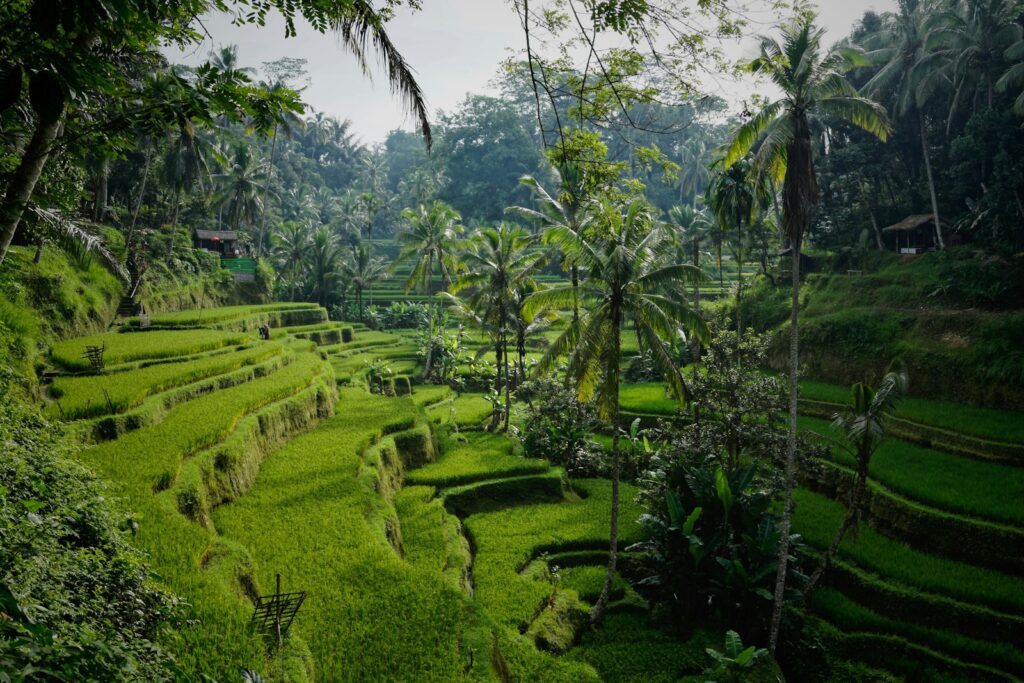
A Tanah Lot temple helicopter tour is a 55-to-75-minute scenic flight that crosses central Bali’s interior — passing above the Batur volcano caldera or Ubud’s rice-terrace belt — before sweeping down the island’s west coast to the famous sea-stack temple at Tanah Lot. Tanah Lot helicopter tour prices sit in the IDR 10,990,000–14,990,000 per seat range for a shared scenic flight (approximately USD 675–950 per person) or IDR 61,000,000–66,000,000 per helicopter for a private grand-tour charter — figures drawn from published 2025–2026 operator rate sheets, not invented from thin air.
\n\n
There is one thing to settle immediately: Tanah Lot does not work as a standalone short flight. The temple sits on the west coast roughly 35–40 kilometres from the South Bali helipad bases at Ungasan and Jimbaran. Flying there and back in 15 minutes is physically impossible. Every legitimate Tanah Lot helicopter route bundles the west coast section with something else — almost always Mount Batur and its caldera, or the Ubud rice-terrace zone, or both. That bundling is not a marketing upsell. It is what the geography requires, and it is what makes these routes genuinely worth the price.
\n\n
What You See on the West Coast Sunset Route
\n\n
The helicopter approaches Tanah Lot from inland, crossing the green coastal scrubland of Tabanan regency before the coastline snaps into view. Then the temple appears below — a black-stone pagoda on a rocky sea stack roughly 100 metres offshore, surf churning around the base, the Tanah Lot estate’s gentle hill rising behind it. At low tide the rocky causeway is exposed and you can see the patterns of the tidal wash; at high tide the stack is cleanly isolated by water. Either way, the geometry is striking: the dark volcanic rock, the white foam lines, the turquoise shallows just inside the reef.
\n\n
Altitude matters here. Most operators fly this section at 1,000–1,500 feet, which gives you a clear view of the temple compound on the stack without being so high that detail is lost. A second pass, if conditions and flight time allow, is worth requesting on a private charter — the sun angle shifts noticeably even in five minutes near sunset, and the difference between one pass and two can be the difference between a strong photograph and a great one.
\n\n
The Temple in Context
\n\n
Pura Tanah Lot is one of Bali’s directional sea temples — part of a chain of coastal shrines oriented toward the ocean. From the ground, at peak visiting hours, you are sharing the viewpoint with hundreds of other tourists. From 1,200 feet, you have the entire coastline to yourself: the temple stack, the reef line, Nyang Nyang beach to the south, and the broad black-sand sweep of the Tabanan coast extending north toward Medewi. This is the view that justifies the price over a ground visit.
\n\n
Sunset timing is where this route earns its reputation. Tanah Lot faces west — the temple pagoda is lit front-on by the dropping sun in the last 90 minutes of daylight, and the silhouette effect against an orange-pink sky is the image most people associate with the place. Operators who market a "west coast sunset flight" are specifically selling that window. Book it for 60–75 minutes before the published sunset time so you arrive at the coast with the sun still above the horizon. Check the sunset time for your date — it varies from around 17:45 WITA in November to 18:20 WITA in July — and work backward from there when requesting a departure slot.
\n\n
The West Coast Beyond the Temple
\n\n
A well-routed 60-minute flight does not just skim the temple and leave. The approach from the north takes you over the black-sand coast between Medewi and Balian — notably less developed than the south coast, more agricultural, with the Batukaru range visible inland. After the Tanah Lot pass, the return leg typically follows the coastline south toward Canggu and Seminyak before cutting inland to base. That return section is worth paying attention to: Canggu’s patchwork of rice fields and surf breaks, Echo Beach, the kilometre-long lineup at Batu Bolong, the contrast between the quiet paddies and the Seminyak hotel strip — all clear from altitude in the late-afternoon light.
\n\n
The Routes: What Gets You to Tanah Lot
\n\n
There are three realistic flight structures that include Tanah Lot, documented across operator brochures and published itineraries. Each one has a different price point and a different experience on the way out.
\n\n
Batur Volcano + West Coast Tanah Lot (60 minutes)
\n\n
This is the most common Tanah Lot itinerary and the one most operators sell as their standard interior-culture product. The flight heads north from the South Bali helipad, crosses the Ubud jungle canopy, and climbs into the highlands above Kintamani. Batur’s caldera opens below — the inner cone at 1,717 metres, Lake Batur stretched out to the north, the lava field on the lower flanks dark against the surrounding green. After an orbit or low pass over the caldera, the route swings west and southwest, picking up the coastal scrubland of Tabanan before arriving at Tanah Lot. Mason Adventures operates a documented 60-minute version on this template; the Raffles Bali 2026 brochure records a 1h 06m variant covering Kintamani – Batur – Lake Batur – Ubud – Tanah Lot.
\n\n
Per-seat cost for this tier: approximately IDR 10,990,000–14,990,000 (USD 675–950). Balicopter’s published "Bali Volcanoes & Temples" rate of IDR 14,990,000 per seat for 75 minutes is the most directly applicable published benchmark.
\n\n
Ubud Rice Terraces + Jatiluwih + Tanah Lot (75 minutes)
\n\n
The longer version is substantially more ambitious. The Raffles Bali 2026 brochure documents this as a 1h 15m routing: Sanur – Ubud – Mount Batur – Jatiluwih rice terraces (UNESCO World Heritage) – Tanah Lot – Nuanu – Kuta Beach. This is the route that earns the "grand tour" label. You cross Sanur’s black-sand coast going east, arc north over Ubud’s Sacred Monkey Forest and the Ayung River gorge, push into the highland caldera at Batur, then pivot west to the Jatiluwih terrace system — broader, older, and more organically shaped than Tegallalang — before the coastal descent to Tanah Lot.
\n\n
Per-seat for this duration: IDR 14,990,000–18,000,000 (USD 940–1,130). Private charter at 75 minutes sits in the IDR 61,000,000–66,000,000+ range based on Raffles brochure data for comparable grand-tour lengths.
\n\n
Coastline Loop with Tanah Lot (45–55 minutes)
\n\n
Some operators offer a west-coastline-focused route that heads directly to the Tanah Lot area from South Bali without the northern volcano detour. Canggu, the Tabanan coast, and a Tanah Lot pass form the core, sometimes extending to Bedugul or the central highlands on a modified arc. This is the faster, lower-cost path to the temple — and the right choice if you have already done a Batur flight and want the west coast specifically. Per-seat pricing for a 45–55 minute route with a Tanah Lot segment runs approximately IDR 8,990,000–10,990,000 (USD 550–690). Balicopter’s published 45-minute Nusa Penida route at IDR 8,990,000 gives a rough duration/price calibration, though the Penida and west coast routes serve different areas.
\n\n
If you are trying to work out which structure fits your itinerary, plan your trip with our concierge — we can help you map the route options against your dates and group size via WhatsApp or the contact form.
\n\n
Price Table: Tanah Lot Helicopter Routes in IDR and USD
\n\n
Both shared-seat and private-charter pricing apply across these routes. Here is an honest summary of the market brackets, sourced from published operator data and documented brochure figures. USD conversions assume approximately IDR 15,500–16,000 per USD; FX shifts these.
\n\n
| Route | Duration | Per Seat (IDR) | Per Seat (USD) | Private Charter (IDR) | Private Charter (USD approx.) |
|---|---|---|---|---|---|
| West coast / Tanah Lot loop | 45–55 min | 8,990,000–10,990,000 | USD 550–690 | 38,000,000–46,000,000 | USD 2,400–2,900 |
| Batur + Tanah Lot (volcano & temple) | 60 min | 10,990,000–14,990,000 | USD 675–950 | 45,000,000–55,000,000 | USD 2,800–3,500 |
| Ubud + Batur + Jatiluwih + Tanah Lot | 75 min | 14,990,000–18,000,000 | USD 940–1,130 | 61,000,000–66,000,000+ | USD 3,800–4,300 |
\n\n
Per-seat rates assume a shared scenic flight with 2–4 passengers; confirm whether your operator requires a minimum fill count or will charge an aircraft-buyout supplement if the flight does not fill. Private charter figures at the 60-minute tier are inferred from documented bracket data — treat as orientation figures and request a current IDR quote from operators directly. The 75-minute private rate is from Raffles Bali’s 2026 published brochure (1h–1h25m grand-tour tier); other operators may price differently.
\n\n
The Private vs Per-Seat Maths
\n\n
For the 75-minute route, the per-seat arithmetic is fairly direct. Four passengers at IDR 14,990,000 each totals IDR 59,960,000. A private charter on a comparable grand-tour route starts around IDR 61,000,000 — a difference of roughly IDR 1,040,000 (about USD 65) for the entire aircraft. At that margin, four passengers who want any degree of routing flexibility should be choosing private. You can ask the pilot to linger above the temple for a second orbit. You can push back the departure by fifteen minutes to catch a better light angle. You are not waiting for a seat to fill.
\n\n
Two passengers are different. Two seats at IDR 14,990,000 each comes to IDR 29,980,000 — roughly half the private charter cost. The per-seat option is significantly cheaper for couples, and the experience is not dramatically different if you are not bothered by sharing the aircraft.
\n\n
The break-even point is three passengers on most routes. At three, the shared-seat cost (IDR 44,970,000) is still meaningfully below the private charter floor. At four, as the maths above shows, the gap narrows to pocket change. This is not theory — it is a calculation worth running before you book anything.
\n\n
Timing the West Coast Sunset Correctly
\n\n
The marketing phrase "sunset helicopter tour" gets applied loosely by operators. Some mean "late afternoon departure with good light." Others mean a departure timed so the aircraft is specifically over Tanah Lot at or just before the horizon drop. These are not the same booking.
\n\n
For the Batur + Tanah Lot 60-minute route, you need to depart the South Bali helipad approximately 60–70 minutes before the time you want to be over the temple. Add transit to the helipad. If sunset is at 18:10 WITA, you need wheels-up by 17:00–17:10 and you should be at the helipad no later than 16:30. Work backward from the sunset time for your specific date — do not rely on the operator’s generic "sunset departure" slot without checking it matches your date’s actual sunset.
\n\n
The dry season months of April through October give the clearest late-afternoon skies and the most reliable golden-hour conditions over the west coast. July and August have later sunsets (18:15–18:20 WITA) which can make scheduling slightly easier. November through March brings earlier sunsets and more cloud build — manageable, but expect more variability in the light quality. The west coast is one of the last parts of the island to lose the afternoon sun, which is one reason Tanah Lot sunset views from the ground are so consistently popular. The same geometry benefits the helicopter route.
\n\n
Departure Points and Getting There
\n\n
All documented operators for this route depart from South Bali heliports. There is no Tanah Lot area helipad for commercial scenic departures — the temple sits in an agricultural zone on the Tabanan coast, and commercial heliport operations require DGCA (Direktorat Jenderal Perhubungan Udara) approval under Ministry regulation PM 94/2015. As of 2025–2026, the active licensed bases are in the south.
\n\n
- \n
- Fly Bali Heliport, Ungasan — Jl. Pantai Melasti no. 8, Ungasan, Kuta Selatan 80363. The most consistently referenced licensed heliport in South Bali; approximately 5.5 nautical miles from Ngurah Rai. Alila Uluwatu, Bulgari, and Ayana Resort are all within a few kilometres. Ground transfer from Seminyak runs 35–50 minutes in typical traffic; from Canggu, budget 45–60 minutes.
- Raffles Bali Helipad, Jimbaran — the documented departure point for Raffles’ published grand-tour routes, including the 1h15m Sanur–Jatiluwih–Tanah Lot itinerary.
- Balicopter heliport, South Bali — exact coordinates are not published; confirm location when booking.
\n
\n
\n
\n\n
If your hotel is in Canggu or Seminyak, factor in the drive to the helipad. Missing a sunset departure slot because of traffic is a painful and avoidable outcome. Ask the operator whether ground transfers are included in the package pricing — some operators serving the South Bali luxury resort corridor include a pickup; others do not.
\n\n
Aircraft and Weight Limits
\n\n
The common aircraft on these longer routes — 60 to 75 minutes — are the Bell 505 Jet Ranger X (one pilot plus up to four passengers) and the Robinson R66 (one pilot plus up to four passengers). The Bell 505 carries Garmin glass cockpit and Bose noise-cancelling headsets; the R66 is lighter and slightly more economical on fuel but has a narrower cabin. For routes at this duration, operators tend to assign the Bell 505 or comparable for passenger comfort over distance.
\n\n
Weight limits are the binding constraint, not seat count. Operators in Bali commonly enforce a soft cap of 100–120 kg per passenger, with total payload (passengers plus luggage) typically set at 320 kg (BaliLook’s published figure) to 350 kg (Fly Bali’s published policy). On a 75-minute inland route with extra fuel load, available passenger payload is smaller than on a short coastal hop. If your group includes larger-framed adults, declare weights at booking — not at the helipad. An operator discovering a weight issue after everyone has arrived for a sunset departure has very limited options and none of them improve your experience.
\n\n
Luggage for a scenic tour means a small camera bag or daypack per person. No rolling suitcases. Camera equipment is permitted within reason; dedicated photography rigs and video equipment should be declared and approved at booking. Doors-off configurations are not standard on scenic tours — they require explicit arrangements, additional safety briefing, and are usually sold as separate aerial photography charters with a minimum 60-minute booking.
\n\n
Cross-Route Context: Batur, Ubud, and Tanah Lot as One Product
\n\n
If you are researching Tanah Lot specifically, you should also read the Mount Batur helicopter tour guide — the two landmarks are sold together by most operators at the 60-minute tier, and the pricing analysis there complements this page directly. Similarly, the Ubud and Tanah Lot page covers the rice-terrace section of the longer 75-minute grand-tour route in detail, including the Jatiluwih UNESCO heritage angle that appears on the Raffles 1h15m itinerary.
\n\n
The practical decision most travellers face is not "Batur or Tanah Lot" — it is "which route length gets me both without padding I do not need." The 60-minute Batur + Tanah Lot structure hits both landmarks efficiently. Add Jatiluwih and Ubud and you are at 75 minutes, which is a longer and more expensive booking but covers the full inland-culture cross-section of the island. Neither is wrong. The 60-minute option is the stronger value-per-minute proposition for most travellers; the 75-minute version justifies its price if the rice terraces are specifically part of the motivation.
\n\n
Booking Practicalities
\n\n
Peak season for Bali helicopter tours is July through August and late December through early January. During those windows, sunset slots on the Batur + Tanah Lot route fill fast — book at minimum two weeks out, and more for private charters. The golden-hour slots are allocated before the midday options every time.
\n\n
Shoulder season (April–June, September–October) allows somewhat more flexibility but popular departure windows still go quickly on weekends. The wet season (November–March) is the only period where you might book a few days in advance without stress — though weather variability is genuinely higher and same-day cancellations more frequent. Reputable operators will reschedule or credit when weather prevents a safe departure under VFR rules; a no-refund-regardless policy is worth treating as a warning sign.
\n\n
One pricing note that operators rarely volunteer: a 10–21% tax and heliport fee may or may not be included in the quoted rate. The Raffles Bali brochure pricing appears tax-inclusive (described as "net"); other operators quote rates that add tax at checkout. Ask specifically: "Is the IDR price you’ve quoted inclusive of all taxes and heliport fees?" The difference between gross and net pricing on a IDR 14,990,000 ticket is IDR 1,500,000–3,150,000 — real money that changes the comparison.
\n\n
Ready to lock in dates or compare options for your group? Plan your trip with our concierge or message us on WhatsApp — we can pull current IDR rates from multiple operators, check availability for your specific sunset timing, and do the private-vs-per-seat maths for your group size before you commit to anything.
\n\n
Frequently Asked Questions
\n\n
How much does a Tanah Lot temple helicopter tour cost in Bali?
\n
A shared per-seat ticket on the most common Tanah Lot route — a 60-minute Batur volcano and west coast combination — runs approximately IDR 10,990,000–14,990,000 per person (roughly USD 675–950 at 2025–2026 exchange rates). The longer 75-minute grand-tour variant including Ubud and Jatiluwih rice terraces costs IDR 14,990,000–18,000,000 per seat. Private charter of the whole aircraft for the 60-minute route typically starts around IDR 45,000,000–55,000,000; the grand-tour private rate sits at IDR 61,000,000–66,000,000+. Always confirm the current IDR price and whether taxes are included — these are 2025–2026 market figures, not operator guarantees.
\n\n
Is there a direct short helicopter flight just to Tanah Lot?
\n
No. Tanah Lot is on the west coast, roughly 35–40 kilometres from the South Bali helipad bases at Ungasan and Jimbaran. A 10 or 15-minute helicopter booking cannot physically cover the transit and return, let alone give you any meaningful view of the temple. The shortest realistic Tanah Lot routing is a 45–55-minute west-coast loop that heads directly to the Tabanan coast without the volcano detour. Most operators sell Tanah Lot as part of a longer 60-minute-plus product that combines the temple with either Mount Batur or the Ubud rice terraces — which is what the geography actually requires and what makes the route worthwhile.
\n\n
What is the best time of day to fly the Tanah Lot sunset helicopter tour?
\n
Late afternoon, timed so the aircraft is above the temple within the last 60–90 minutes of daylight. Tanah Lot faces west and is lit front-on by the setting sun in that window — the silhouette of the pagoda against an orange-lit ocean is the view that defines the route. For a 60-minute Batur + Tanah Lot flight, depart the South Bali helipad roughly 60–70 minutes before your target time over the temple. Sunset in Bali ranges from about 17:45 WITA in November to 18:20 WITA in July — check the exact time for your travel date and work backward. Morning departures are better for Batur caldera and rice-terrace photography; sunset is specifically the Tanah Lot advantage.
\n\n
Does the Tanah Lot helicopter tour also fly over Mount Batur?
\n
On most 60-minute and longer routes, yes. The standard itinerary heads north from South Bali into the highland interior, passes over or orbits the Batur caldera and Lake Batur, then swings west and south along the Tabanan coastline to Tanah Lot. This is the template documented by Mason Adventures (60-minute) and Raffles Bali (1h 06m variant). A direct west-coast-only route to Tanah Lot, without the volcano, exists as a separate and shorter product with some operators — confirm the exact routing with your operator at the time of enquiry, as route inclusions vary by aircraft, scheduling, and wind conditions on the day.
\n\n
Can I see Tanah Lot from the helicopter at low tide vs high tide?
\n
Both are worthwhile, but they look different. At low tide, the rocky causeway connecting the sea stack to the shore is visible from above — you can see the tidal wash patterns and the scale of the base relative to the pagoda above it. At high tide, the stack is cleanly isolated by water and the temple reads as a true island. Most photographers prefer high tide for the cleaner separation, but the low-tide rocky geometry is equally interesting from altitude. Neither condition makes the flight less worthwhile, and the pilot cannot time the tides to the helicopter route — check tide tables for your travel date if this distinction matters to you.