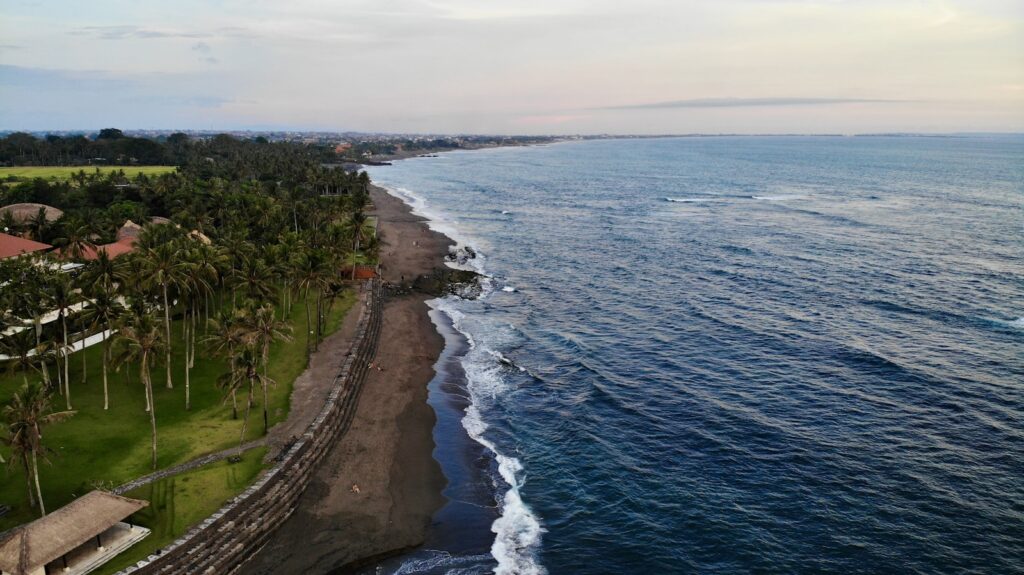
On a doors-off helicopter in Bali, all camera gear must be physically secured to your body or to a provided aircraft anchor point before the aircraft lifts. No loose items are permitted inside the cabin once the door is removed — not a lens cap, not a second body on a seat beside you, not a telephoto balanced on your lap. The rule is not operator pedantry; an unsecured DSLR at orbiting altitude and speed becomes a projectile risk to the tail rotor and to anyone below. This page covers every camera and clothing rule you will encounter, the gear choices that actually work at altitude, and what to confirm with your operator before you show up at the helipad.
Doors-off photography charters in Bali are not a standard product — they are arranged individually by WhatsApp or email, usually priced at USD 3,000–5,000 or more for a 60–120 minute shoot, and require a specific aircraft type and pilot clearance. If you have not yet read the full context on how these flights are structured and priced, the Bali doors-off photography flight guide covers the booking process, route selection, and timing in detail. This piece focuses on gear.
The Non-Negotiable Rule: Everything Tethered
Start here, because everything else is secondary. Bali helicopter operators apply a simple test at the pre-flight briefing: pick up your camera and demonstrate that if you let go of it completely, it cannot leave the aircraft. That means a dual-attachment tether system — not a single wrist strap, not a neck strap that can ride over your head in a banked turn, but a load-bearing harness or lanyard with at least two independent connection points.
The physics are straightforward. An AS350/H125, the most common aircraft for Bali aerial photography charters, orbits at low altitude with the aircraft in a sustained banked turn. In that position, the effective g-load and the centrifugal effect on anything not firmly held are real. A camera body with a 70–200mm lens attached weighs 2.5–3.5 kg. In a banked turn with a brief moment of inattention, a single neck strap is not enough. Operators know this and will refuse boarding to anyone whose securing system does not meet their standard.
Accepted tether systems break into two categories:
- Body harness with dual attachment points
- Systems like the BlackRapid Double Breathe, Peak Design Capture Clip with dual-anchor sling, or similar load-bearing harnesses that distribute the camera weight across the chest and attach to a D-ring at both the strap ends. The camera is clipped, not looped. These are the professional standard for aerial photography and worth owning if you are serious about doors-off work.
- Aircraft tether lanyard
- A short braided nylon lanyard (typically 30–60 cm, rated to at least 20 kg) connecting the camera strap lug or body D-ring to an aircraft attachment point. Many operators provide these; bring your own as backup. The lanyard creates a hard limit on how far the camera can travel even if the primary harness fails. Use this in combination with a body harness, not instead of one.
One combination that consistently works: body harness for shooting comfort and weight distribution, plus a secondary lanyard to the aircraft point as the hard backup. Two points of failure required before the camera is free. That is the standard serious aerial photographers use globally, and Bali operators running doors-off charters expect it.
Camera Bodies and Lens Choices
The question is not which camera is best in some abstract sense; it is which camera-and-lens combination works within the physical constraints of a banked helicopter at low altitude. That filters the options considerably.
Mirrorless vs DSLR
Mirrorless bodies have a meaningful advantage for doors-off helicopter work: they are lighter, which matters when you are flying with a total payload cap. Fly Bali enforces a total pax-plus-luggage limit of 350 kg; BaliLook cites 320 kg. With a pilot, one or two photographers, and a camera bag, you have practical payload headroom, but every kilogram of equipment declared upfront affects the maths. A Sony A7 IV body at 658 g versus a Nikon D850 at 1,005 g is not a trivial difference when you are carrying two bodies and three lenses and the operator needs your exact gear weight declared at booking.
In-body image stabilisation (IBIS) on modern mirrorless systems is a genuine benefit at helicopter vibration frequencies. Helicopters produce a characteristic low-frequency vibration through the airframe; IBIS handles this better than lens-only stabilisation on most focal lengths. The Sony A7 series, Nikon Z series, and Canon R series all perform well. None of this matters if the gear is not properly secured — stabilisation helps with vibration; it does not compensate for blur from camera shake caused by poor grip in turbulence.
Focal Length: What Actually Works
The dominant working range for Bali aerial photography is 16–70mm. Here is why: the value of a doors-off helicopter over Nusa Penida or the Bukit Peninsula cliffs is the close-in, low-altitude perspective that puts you physically adjacent to cliff faces, reef edges, and temple headlands. That geometry rewards wide and standard focal lengths. You do not need to zoom to compress a distant subject because your subject is not distant — you are 50–150 metres away from Kelingking Beach’s headland on a low orbiting pass.
| Focal length | Practical use case | Notes |
|---|---|---|
| 16–24mm (wide) | Caldera overview (Batur), full cliff-face context shots, Ceningan Channel geometry | Best for scale and environmental context; manages barrel distortion in post |
| 24–35mm (standard-wide) | Most versatile focal length for coastal and island work; Kelingking headland profile | The sweet spot for the majority of Bali aerial subjects; light and manageable |
| 35–70mm (standard-normal) | Isolating specific features: Uluwatu temple on its headland, Broken Beach ring, reef colour | Useful second lens; carries fine, manageable weight |
| 70–200mm f/2.8 | Wildlife (Manta Point), distant temple compression, portrait-format coastal shots | The longest routinely used on Bali aerial shoots; declare upfront; IBIS critical at 200mm in vibration |
| 200mm+ | Specific wildlife or distant subject compression | Discuss with operator before booking; physical management in banked turns is harder; rarely necessary given low-altitude proximity |
A practical two-lens setup that most aerial photographers settle on for Bali: a 16–35mm f/2.8 as the primary and a 70–200mm f/2.8 secured in the bag for selective moments. Two bodies, one lens each, both tethered, is cleaner than swapping lenses in an open-door cabin. The 24–105mm f/4 as a single-lens solution is also a strong choice when you want one focal-length versatile tool without managing two separate systems simultaneously.
Filters
Polarising filters are useful on Bali aerials because much of the visual payoff — the turquoise of the Ceningan Channel, the shallow reef colour near Nusa Lembongan, the ocean glare over Manta Point — responds to polarisation angle. A circular polariser on your primary lens is worth carrying. Variable ND filters are trickier: the X-pattern artefact that variable NDs produce at certain rotation angles is visible at wider apertures, and you may not have the bandwidth to manage rotation precisely while shooting from a moving aircraft in a banked orbit. A solid fixed-density ND (3-stop for bright midday conditions) is simpler to manage.
Whatever filters you use: attach them before boarding and do not unscrew them mid-flight. A filter dropped inside an open-door cabin is a loose-object incident. Bring spares in a closed, zipped pouch in your bag, not rattling loose in a pocket.
GoPro and Action Camera Rules
GoPros and similar action cameras are permitted on helmet mounts and secure body harness mounts. They are not permitted on extending pole arms, flexible Gorillapod-type rigs attached to the aircraft exterior, or any mounting arrangement that positions the camera outside the cabin on a rigid arm that can catch airflow.
The distinction matters for a practical reason: a GoPro on a 20cm rigid arm extended through the door opening creates a lever that, in a strong side-wind or turbulent condition, exerts a torque back through the mount onto the attachment point. Standard aircraft interior attachment points are not designed for that load direction. Operators will require you to retract or remove any such rig before flight.
What works cleanly:
- Helmet mount (GoPro standard adhesive or locking clip): the established method. Gives first-person perspective, keeps both hands free for your main camera, adds no load to the aircraft. Confirm the mount adhesion is solid before the flight — a GoPro popping off inside a moving cabin is a loose-object incident regardless of how small it is.
- Chest harness mount: lower profile than helmet, good for a second angle when shooting video and stills simultaneously. The GoPro Media Mod or similar body-mounted accessories are fine provided they are clipped, not just resting against the harness.
- Seatbelt or aircraft-anchor lanyard mount: some operators provide mount points on the seatbelt receiver or interior frame specifically for action camera tethering. Use these where available; they keep the action camera entirely inside the aircraft and on a secure anchor.
Battery packs for GoPro and action camera power banks: permitted, but store them in a sealed pouch or bag clipped to your harness — not on the seat, not in an open cargo pocket. Every loose item in the cabin is a potential problem if the flight profile gets dynamic.
Clothing Rules
Clothing rules are enforced, not suggested. Every reputable helipad in Bali will turn away passengers in footwear or clothing that fails the standard, and for a doors-off charter, the bar is higher than for a closed-door scenic flight.
Footwear
Closed-toe shoes with secure ankle coverage are mandatory. Sandals, flip-flops, and open-toed shoes are refused. The reasoning is both boarding safety — moving around a running helicopter’s rotor zone in flip-flops carries obvious risks — and in-flight: a sandal that works loose inside an open-door cabin is a loose object. Wear trail runners, sneakers, or low hiking shoes. The more securely your footwear attaches to your foot, the better. Lace-up is preferable to slip-on.
Clothing Fit and Loose Fabrics
The rotor downwash on an AS350 is roughly 80–100 km/h directly below the disc. In an open-door cabin during a banked orbit, the effective airstream across a passenger’s upper body runs 40–80 km/h depending on airspeed and bank angle. Anything not secured will be stripped away. Specifically:
- Scarves: not permitted unless tied tightly against the body and tucked inside a jacket collar. A loose scarf in a banked orbit can contact the window frame or door opening — operators refuse these at the briefing.
- Wide-brimmed hats: not permitted. Baseball caps with a forward-fitting chin strap, or a close-fitting beanie, are the alternatives. A standard Bucket or Akubra-style hat is not secure regardless of how hard you hold it.
- Open-front jackets and oversized shirts: the issue is flapping fabric catching the seat harness or interfering with harness fit assessment. Wear a close-fitting base layer that the operator can properly secure the harness over. If you need warmth at altitude — and on an early morning Batur route at 1,700 m you might — a fitted softshell or athletic midlayer is the right choice.
- Long hair: must be tied back and preferably tucked into a collar or base layer. Loose long hair in rotor downwash and cabin airstream tangles and creates distraction. Braid it, tie it, or use a buff. This is a practical issue, not aesthetic.
The Harness Layer
Operators provide and fit the passenger harness at the helipad. Most doors-off charters use a 4-point or 5-point seat harness that secures across the chest and lap, plus an additional tether to an aircraft hard point. The harness is fitted over your clothing. If you are wearing a bulky parka or a thick fleece, the operator needs to be able to assess harness fit properly — a harness that fits loosely because of bulk under it is not doing its job. Wear fitted layers and carry an outer layer in your bag to put on at altitude if needed, rather than starting the harness fitting process in your heaviest jacket.
Sun protection matters at altitude. A 90-minute session in direct sun at helicopter operating altitude with no glass between you and the sky produces meaningful UV exposure. Apply sunscreen before boarding; bring a thin buff or neck gaiter as optional face coverage. Polarised sunglasses help with glare management and protect your eyes from the airstream — use them with a retaining strap so they cannot come off.
What You Cannot Bring
A short list of gear that will not be allowed on board:
- Drones: launching a drone from a helicopter in flight is not permitted. Helicopter and drone operations require separate permits and are conducted on separate flights. If your production needs both, plan for two separate sessions.
- Large rigid tripods or heavy video rigs: a full-sized carbon tripod is not a practical doors-off tool and most operators will not permit large rigid equipment in the cabin. A compact fluid head and a very small travel tripod are sometimes used for static ground work before or after a flight, not during. Gimbal stabilisers (DJI RS series) for video work are generally permitted if properly secured to the body — confirm with your operator during booking.
- Bags with unsecured openings: an open camera bag on the seat beside you in an open-door cabin is a risk. Use a zipped bag with a clip or strap that can be anchored. If your lens changes happen mid-flight (generally inadvisable), do them from a bag that is secured to your harness, not resting freely beside you.
- Aerosol cans, pressurised containers, excess batteries beyond declared quantity: standard aviation dangerous goods rules apply. Lithium battery quantity must be declared at booking; large quantities (professional video productions with multiple large-format batteries) may require special handling discussion.
Operator Approval: What to Confirm Before You Book
Gear rules are partly universal (tethering, clothing) and partly operator-specific. Two questions to ask every operator before you pay a deposit:
First: “Which aircraft will be assigned for this doors-off charter, and is it specifically cleared for doors-off operation?” Not every helicopter in Bali’s fleet is certified for doors-off work. The AS350/H125 Écureuil and the Bell 505 are the most commonly cited in Bali operations; the Robinson R66 is also in use for tourism. Each type has different door configurations and different approved operating envelopes for doors-off. Get the aircraft type and registration (PK- prefix, Indonesian-registered) confirmed in writing as part of your booking.
Second: “Walk me through your harness and securing procedure for passengers.” A legitimate operator running a genuine doors-off charter will describe a specific procedure: harness type, fit check by the pilot or briefing officer, secondary tether points, and what action the pilot takes if turbulence develops mid-flight. If the answer is vague or the operator cannot describe the procedure with any specificity, this is a significant warning flag. Doors-off operation without a properly documented securing procedure is not a service you want to be on.
The operator should also hold a valid AOC 135 (Air Operator Certificate, on-demand charter) from Indonesia’s DGCA (Direktorat Jenderal Perhubungan Udara). Urban Air Helicopters operates under this certification in Bali; legitimate operators will provide their AOC reference without hesitation. This is the regulatory baseline for any commercial helicopter charter, doors-off or otherwise.
If you want a neutral starting point for comparing which operators currently hold active doors-off approvals and can take your booking dates, plan your trip with our concierge. We compare operators without commission pressure and can run the safety questions on your behalf. WhatsApp is fine for initial planning — most Bali operators respond faster there than by email, and our team works across both.
Gear Checklist Summary
A practical pre-flight gear check:
- Camera bodies
- Tethered via dual-attachment harness plus secondary aircraft lanyard. Weight declared to operator at booking. IBIS on or lens-IS on as applicable.
- Lenses
- Primary wide-to-standard (16–35mm or 24–105mm). Optional second lens (70–200mm maximum for undiscussed use; anything longer pre-approved with operator). Filters attached before boarding, spare filters in sealed pouch.
- Action camera
- GoPro on helmet or chest harness mount, confirmed secure before boarding. No extending arms outside the cabin.
- Clothing
- Closed-toe shoes, lace-up preferred. Fitted base layer for harness fit. No loose scarves, no wide-brimmed hats, no open-front jackets. Long hair secured. Sunscreen applied pre-board. Polarised sunglasses with retention strap.
- Bag
- Zipped, clipped or strapped to harness. No open pouches rattling free in the cabin.
- Documentation
- Aircraft type and registration confirmed in writing. AOC 135 number on file. Harness procedure understood. Cancellation policy confirmed before deposit.
Frequently Asked Questions
Do I need to bring my own tethers, or does the operator provide them?
Most operators provide a safety lanyard to the aircraft anchor point, but they do not provide a body harness for your camera system — that is your gear. Bring a professional camera harness with dual attachment points (BlackRapid Double, Peak Design, or similar) as your primary securing method. Treat the operator-provided lanyard as the secondary backup. Do not rely on a single neck strap or wrist loop; the operator’s pre-flight check will catch this and you will not board until the securing system meets their standard.
Can I use a gimbal or stabiliser rig on a doors-off helicopter in Bali?
Compact gimbal stabilisers (DJI RS3 or similar body-mounted systems) are generally permitted provided they are secured to your body and the overall camera-plus-gimbal weight is declared at booking. Large studio rigs, cage systems with multiple arms, and any rig that extends significantly outside the aircraft body are not. Discuss your exact stabiliser setup with the operator during the booking conversation — do not show up with undisclosed equipment and expect a clearance on the day.
Are there specific gear rules for the Nusa Penida doors-off route versus Batur?
The core rules — tethering, clothing, harness — are the same regardless of route. The practical gear difference is focal length choice: the Nusa Penida cliff loop rewards wider lenses (16–35mm) for its close-in coastal geometry and the Ceningan Channel overview, while the Batur caldera at altitude also favours wide angles for capturing the geological scale. On a Batur sunrise session, dress warmer — the mountain sits at around 1,700 metres and early morning temperatures are notably cooler than South Bali. A fitted softshell mid-layer is worth bringing for the caldera section even on a route where the South Bali legs are warm.
What happens if my camera is not tethered correctly at the helipad?
The operator will not allow you to board with unsecured gear. Pre-flight briefings on doors-off charters specifically check that all camera equipment is properly secured before the aircraft doors are removed. If your securing system does not meet the operator’s standard, you will be asked to correct it on-site or leave the equipment behind. This is non-negotiable and not negotiable on the day with a sympathetic argument about missing the flight window. Arrive with your harness already set up and tested, not still in the box.
Can I change lenses during the flight?
Technically possible but not recommended in an open-door cabin, particularly during a banked orbit. The main risk is a dropped lens cap, filter, or lens itself during the swap. If you need two focal lengths, fly with two separate tethered bodies each carrying a prime or short zoom. If that is not possible, plan lens changes during level, steady segments of the flight — not mid-orbit over Kelingking — and keep the removed lens immediately inside a clipped-shut bag on your lap, not resting on the seat or perched on the door frame.