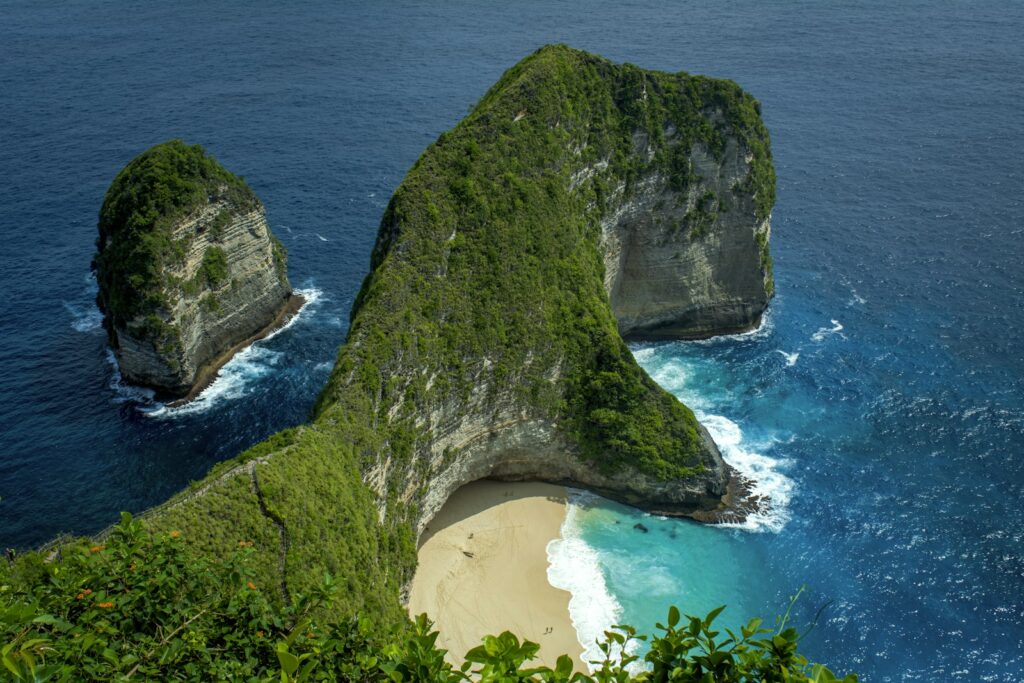
A Crystal Bay and Broken Beach helicopter tour Bali visitors book is a 42-to-55-minute scenic flight that departs from a South Bali helipad, crosses the Nusa Channel, and arcs around Nusa Penida’s western cliff coast — putting Broken Beach’s collapsed sea-cave ring, Angel’s Billabong, Crystal Bay, and Kelingking’s T-Rex headland directly beneath you in a single pass. No road on Penida connects these sites in sequence; the only way to see them laid out geographically is from altitude. Per-seat pricing on a shared flight runs roughly USD 550–600 (around IDR 8,500,000–9,000,000); private charter for the whole aircraft sits at USD 2,400–3,000 depending on route length and operator.
This piece covers the specific landmarks on Nusa Penida’s west coast, what altitude reveals that ground visits cannot, how the routing works, and how much the various flight lengths cost. I have flown routes in this corridor more than once; the observations below are grounded in those flights and cross-checked against published operator data from Balicopter, Fly Bali, and the Raffles Bali 2026 helicopter brochure.
What Nusa Penida’s West Coast Actually Looks Like from the Air
Stand at the rim of Broken Beach on the ground and you see a circular void — a collapsed sea cave about 160 metres across, its arch intact on the seaward side, turquoise water trapped inside. It is impressive. From a helicopter at roughly 200–300 metres altitude, something different happens: the geometry becomes perfect. The collapse reads as a near-flawless circle punched into white limestone, the arch casting a shadow across the pool below, the surrounding cliff texture throwing the colour of the water into sharp relief. The circular framing effect that social media photography tries and mostly fails to achieve on the ground is simply there from above, without any effort.
Angel’s Billabong sits adjacent — a natural rock pool carved into the shoreline, open to the ocean on its seaward face. At ground level it is a tidal curiosity, beautiful at low tide and dangerous at high. From altitude it reads as a shallow lagoon, its floor visible, the wave surge arriving and retreating across it in visible pulses. Neither site is more than a kilometre apart. A competent pilot will orbit both in a single pass.
Crystal Bay, roughly two kilometres south of Broken Beach, is a calmer proposition visually. It is a sheltered cove — one of the few genuinely protected anchorages on Penida’s otherwise exposed west coast. The bay shows pale green in the shallows grading to deeper blue toward the mouth; it is famous at sea level for mola mola sightings (oceanic sunfish) in the August-October window, though you will not see them from a helicopter. What you will see is the contrast between Crystal Bay’s protected geometry and the open-coast violence of the rest of Penida’s western escarpment. That contrast is the aerial argument for including it in your route.
Kelingking Beach, further north on the west coast, is the landmark that has defined Nusa Penida’s image internationally. The headland’s T-Rex skull profile — the formation that makes it distinctive — is only legible from one direction: approaching from the west or north-west at low altitude. Approach from the wrong angle or too high, and it reads as a generic cliff spur. A good operator knows exactly where to position the aircraft. The beach at the base of the headland, accessible only by a difficult cliff descent on foot, is tiny from above — maybe 80 metres of white sand hemmed in by vertical rock faces — and the scale of the cliff dropping to it is clearer from altitude than from anywhere on the ground.
How the Route Is Structured (and Why Duration Matters)
The South Bali helipads that serve these tours — Fly Bali’s registered heliport at Ungasan, Raffles Bali’s helipad in Jimbaran, and a few others on the Bukit Peninsula — sit roughly 25 kilometres from Nusa Penida’s west coast. At typical cruise speed for the light turbine and piston helicopters used in Bali (Airbus H125, Bell 505, Robinson R66), that transit eats approximately 8–10 minutes each direction. You do not see Penida until 10 minutes into your block time, and you are heading back before 10 minutes remain.
That math matters. A 30-minute flight from Ungasan does not reach Crystal Bay and Broken Beach in any useful sense. The numbers add up like this: 10 minutes outbound transit, 10 minutes of coastline, 10 minutes inbound. You might catch a glimpse of Kelingking from a distance and turn for home. Operators who list a “Nusa Penida from” price without specifying at least 42 minutes are selling a transfer or a very partial pass — not the west-coast loop this piece is about.
The established route configurations that genuinely cover the west-cliff sequence are:
The 42–45 Minute West Coast Loop
This is the minimum that works. Some operators structure it as: depart Ungasan/Jimbaran, cross the Nusa Channel, pick up Nusa Lembongan first (Devil’s Tears blowhole on Lembongan’s south-west corner, the Yellow Bridge between Lembongan and Ceningan), then sweep south and east around Penida’s west coast: Broken Beach and Angel’s Billabong together, Crystal Bay, Kelingking, Manta Point at the south-west tip, then return north. Other operators skip Lembongan and spend those minutes on a more detailed orbit of Penida’s cliff sequence. Both approaches cover the Crystal Bay–Broken Beach–Kelingking triangle.
Published per-seat pricing for 42–45 minute Nusa Penida scenic flights sits at IDR 8,999,000 on Balicopter’s published rate card — approximately USD 560–600 per person at current exchange rates. The Raffles Bali 2026 brochure prices the comparable private charter at IDR 38–46 million for the whole aircraft, which works out to roughly USD 2,400–2,900. These are real published figures, not estimates.
The 55-Minute Four-Island Extension
This adds GWK (the Garuda Wisnu Kencana statue complex) and Melasti Beach on the South Bali coastline, usually on the return leg. The Crystal Bay–Broken Beach–Kelingking loop is the same; you are buying extra South Bali cliff coverage. Per-seat pricing steps up to around IDR 10,990,000 (roughly USD 680–730); private charter runs IDR 45–46 million, approximately USD 2,800–3,100.
The incremental case for the four-island version: if you have not flown the Bukit Peninsula coast before and want to see Uluwatu’s cliff corridor and GWK from altitude in the same session, the extra 13 minutes and moderate price jump makes sense. If you specifically want the Nusa Penida west coast as thoroughly as possible and the South Bali coast is secondary, the 45-minute loop is the more focused purchase.
Crystal Bay and Broken Beach Helicopter Price: What the Market Charges
The table below organises the pricing picture. These are market brackets drawn from published operator data — Balicopter’s public rate sheet, Fly Bali’s tier structure, and the Raffles Bali brochure — not a quote from any single company for any single date. Exchange rates, seasonal promotions (operators periodically run 10–15% discounts), and group size all shift the final number.
| Route / Duration | Per Seat, Shared Flight | Full Aircraft, Private Charter | Key Landmarks Covered |
|---|---|---|---|
| 42–45 min Nusa Penida west-coast loop | ~USD 550–600 (IDR 8,500,000–8,999,000 published) |
~USD 2,400–2,900 (IDR 38–46M brochure) |
Broken Beach, Angel’s Billabong, Crystal Bay, Kelingking, Manta Point |
| 42 min incl. Lembongan & Ceningan | ~USD 550–580 (IDR 8,500,000–9,000,000) |
~USD 2,400–2,700 (IDR 38–43M) |
Adds Devil’s Tears, Yellow Bridge, Ceningan Channel to above |
| 55 min four-island circuit | ~USD 680–730 (IDR 10,990,000 published) |
~USD 2,800–3,100 (IDR 45–46M brochure) |
Full west-coast loop plus GWK & Melasti on return |
| Transfer only, Ungasan → Nusa Penida (no loop) | ~USD 400–440 (IDR 6,590,000 published) |
~USD 1,500–2,500 (tier & operator dependent) |
Lands on Penida; scenic coverage limited to transit corridor only |
A note on what these prices include: tax and heliport-fee treatment varies by operator. Some quote net (all-inclusive); others add 10–21% on top. The Raffles Bali brochure figures appear to be net of service charges. Ground transfers to the helipad — from your hotel to Ungasan, typically — are sometimes included within a resort package and sometimes charged separately. Confirm both points explicitly before placing a deposit.
When Four People Changes the Maths
At USD 550–600 per seat, a group of four on a shared flight pays USD 2,200–2,400 combined. A private charter of the same route costs USD 2,400–2,900. At four passengers you are at or past the break-even point. You get your own cabin, a departure time you choose, the option to request a longer orbit over specific sites — and no strangers in the frame if you are shooting.
Couples will almost always find the per-seat shared option more economical: USD 1,100–1,200 for two seats versus USD 2,400–2,900 for privacy. That USD 1,200–1,700 gap is real. The case for going private as a pair is specific: proposal flights, dedicated photography passes with the door configuration you need, or a tight scheduling constraint that shared departures cannot meet.
Solo travellers booking a shared flight should be aware that “shared” does not always mean instant availability — operators may need a minimum number of confirmed passengers before a flight departs, particularly outside peak season. Ask whether your slot is guaranteed or waitlisted against a minimum passenger count.
The Lembongan Leg: Worth the Detour?
Not every Nusa Penida route includes Nusa Lembongan and Ceningan. Some 45-minute formats skip those islands entirely and spend the extra minutes on a more thorough orbit of Penida’s west coast. Whether that trade-off suits you depends on what you want from the flight.
If the Crystal Bay–Broken Beach–Kelingking sequence is the point — the dramatic limestone cliff coast, the geometric formations, the scale of the escarpment — then concentrating on Penida makes sense. You get a longer approach to each landmark, more time to orient to what you are seeing, and potentially a second orbit over a site if light conditions are right.
If you want to see the Nusa group as a whole geographic unit, the Lembongan-Ceningan leg adds real visual value. The Ceningan Channel — the narrow strait between the two small islands — runs a brilliant turquoise caused by shallow depth over white sand, and the colour contrast against the dark rock edges is one of the best aerial colour photographs available on any Bali route. Devil’s Tears on Lembongan’s south-west corner is active at almost any swell height; the white water plume is visible from altitude and gives the site its drama even when the sea state is moderate. The Yellow Bridge reads as a graphic element from above — a thin yellow line connecting two low green islands — in a way it simply does not from the roadside.
My honest recommendation: if you are coming specifically because you have been to Penida by fast boat and want to see it from the air, the Penida-focus loop gives you more time with the landmarks you already have context for. If this is your first close look at the Nusa group and you want spatial understanding of the whole cluster, the version that includes Lembongan and Ceningan is the better orientation flight.
Ready to sort the specifics for your group? Plan your trip with our concierge — we help you compare operators, check current pricing and availability, and flag the questions worth asking before you pay a deposit. WhatsApp planning works too; most operators in Bali respond faster on WhatsApp than by email anyway.
Aerial Photography Over the West Cliffs: What Doors-Off Means Here
The west-cliff sequence on Nusa Penida is one of the primary locations for doors-off aerial photography in Bali. The combination of dramatic subjects — the perfect circle of Broken Beach, the Ceningan Channel’s colour, Kelingking’s profile — and the relatively compact routing makes it an efficient photography target.
Doors-off flights are not a standard product you click and buy. They are bespoke charters, arranged via email or WhatsApp, with a minimum booking of typically 60 minutes (often 90 or 120 for serious shoots), and priced meaningfully above standard scenic rates. Serious aerial photography sessions over the Nusa islands run in the range of USD 3,000–5,000 or more depending on aircraft, route length, and how many orbiting passes are needed. That cost reflects the additional fuel burn of low-speed orbiting and hovering, the pre-flight coordination required, and the specific certification the aircraft needs for doors-off operations.
The aircraft door configuration, harness type, and gear-securing requirements vary by helicopter model. On the Bell 505 or Airbus H125, the rear doors can be removed; on the Robinson R66, the configuration differs. Your operator will specify what gear-securing is required (nothing unsecured, camera straps must be rated, loose fabrics prohibited). The Ceningan Channel looks best from approximately 150–200 metres altitude on a clear morning — the turquoise is washed out by overhead sun after about 11:00. Kelingking’s T-Rex profile requires a westward approach; confirm the pilot knows the specific angle before the session, not on the way there.
Ground Visit vs Aerial: Two Different Experiences
Nusa Penida by fast boat from Sanur takes 30–45 minutes each way and costs around USD 10–25 per person. A full day on the island gives you the cliff-top views of Kelingking, the rim walk at Broken Beach, the tidal pool at Angel’s Billabong, a swim at Crystal Bay. The roads are rough, the distances between sites add up, and the full west-coast circuit is a long day — but it is an exceptionally good one.
The helicopter overflight is a categorically different thing. It does not replace the ground visit. It gives you the cliff faces in their full vertical scale — standing at Broken Beach’s rim you see the opening, not the circle; only altitude reveals the geometry. It gives you the relationship between sites: Broken Beach and Angel’s Billabong are adjacent, Crystal Bay is a calmer pocket two kilometres south, Kelingking is a further stretch north — the spatial logic of the west coast makes sense in a 10-minute aerial pass in a way that takes a full day of driving to approximate on the ground.
The honest case for doing both: go by boat first. The ground visit gives you scale, context, and the visceral sense of these cliffs. Then fly. You will recognise every feature and see things you could not have understood from the road. Travellers who approach the helicopter having never been to Penida sometimes struggle to parse what they are looking at. Travellers who have done the island by boat and then fly over it typically describe the flight as the more memorable experience — not because it is inherently better, but because the context makes it land differently.
For cross-links on the broader Nusa Penida flight options, see the full Nusa Penida helicopter tour price page. For the mechanics of what shared versus private charter actually costs at each flight length across all Bali routes, the master price guide has the complete breakdown.
Helipad, Timing, and the Weather Variable
Flights to Nusa Penida’s west coast depart from the South Bali helipad cluster: Fly Bali’s registered heliport at Jl. Pantai Melasti, Ungasan (about 5.5 nautical miles from Ngurah Rai, in the resort corridor near Alila Uluwatu, Bulgari, and Ayana), plus Raffles Bali’s Jimbaran helipad and the GWK helipad on the Bukit. Ground transfer from hotels in Nusa Dua or near Uluwatu is short — 15 to 30 minutes. From Seminyak or Canggu, budget 60–90 minutes each way in normal Bali traffic.
Standard operating windows run approximately 10:00 to 16:30. Morning departures give better lighting for photography — the cliff faces on Penida’s west coast face west, which means they are in shade during early morning and lit directly by afternoon sun; for overhead shots of Broken Beach and Crystal Bay, the 10:00–12:00 window produces the clearest water colour. The afternoon sea breeze across the Nusa Channel (Lombok Strait side) picks up from early afternoon and can introduce noticeable turbulence on the return leg, particularly in October, November, March, and April.
Wet season (roughly November through March) brings afternoon convective cloud that can obscure the south-west Penida cliff line. Morning slots through most of the wet season remain workable; same-day cancellations are more common. Dry season (April through October) gives the most reliable conditions; July and August are peak crowd and peak visibility together. Book one to two weeks ahead for July–August departures; in shoulder season a few days’ notice usually works but weather flexibility helps.
Go/no-go decisions happen on the morning of the flight. A reputable operator will offer a full reschedule or refund on a weather cancellation. Get that policy in writing at the time of deposit — not after.
Frequently Asked Questions
How much does a Crystal Bay and Broken Beach helicopter tour from Bali cost?
Per-seat pricing on shared scenic flights that cover the Nusa Penida west-coast loop (Broken Beach, Angel’s Billabong, Crystal Bay, Kelingking, Manta Point) runs roughly USD 550–600 per person, or IDR 8,500,000–8,999,000 at published Balicopter rates. Private charter for the whole aircraft on the same 42–45 minute route sits at approximately USD 2,400–2,900 (IDR 38–46 million per Raffles Bali brochure data). The 55-minute version adding GWK and Melasti on return costs around USD 680–730 per seat or USD 2,800–3,100 for a private aircraft. USD figures assume IDR 15,000–16,000 to the dollar; exchange rates and operator promotions adjust the final number.
Can you see Crystal Bay and Broken Beach on a short helicopter flight from Bali?
Not on a 15 or 20-minute flight. The South Bali helipads sit roughly 25 kilometres from Nusa Penida’s west coast; transit takes about 10 minutes each way at cruise speed. That leaves almost no time over the landmarks on a short block. You need a minimum of 42–45 minutes booked to actually fly the Crystal Bay–Broken Beach–Kelingking sequence. Any operator advertising a Nusa Penida overflight at 20–30 minutes is either selling a one-way transfer (which lands, not loops) or a very partial pass that will not cover the west-cliff sites.
Is Crystal Bay visible from a helicopter, or is it too small to see?
Crystal Bay is clearly visible from altitude — it is a sheltered cove of roughly 300–400 metres across on Penida’s west coast, with characteristic pale green shallows grading to deeper blue toward the bay mouth. From a helicopter you can see the geometry of the cove, the contrast between its protected water and the exposed coastline flanking it, and (in good light) the colour graduation that makes it recognisable in aerial photography. You will not see mola mola (oceanic sunfish) from altitude; those are a diving experience. The aerial value is the cove’s position in the landscape and the colour contrast, both of which are clear on any cloudless morning.
Does the helicopter tour land at Broken Beach or Crystal Bay?
No — a standard scenic helicopter tour overflies these sites without landing. There are no helipads at Broken Beach, Angel’s Billabong, or Crystal Bay. The flight circles the landmarks at altitude and returns to the South Bali departure helipad. If you want to visit these sites on the ground, the route is by fast boat from Sanur to Nusa Penida (30–45 minutes, USD 10–25 per person) followed by road transport on the island. A helicopter transfer flight can land at a designated helipad elsewhere on Nusa Penida, but that is a separate product at different pricing and does not deliver you to the west-coast sites.
What is the best time of day to fly the Nusa Penida west-coast helicopter route?
The 10:00–12:00 window works well for most purposes. Broken Beach and Angel’s Billabong face roughly south-west; the water colour inside the collapsed cave is clearest when the sun is higher and the interior of the formation is lit. Crystal Bay’s shallow floor shows the best turquoise before midday. Kelingking’s T-Rex headland receives direct light on its west face from late morning onward — the cliff is more visually legible under direct sunlight than in flat morning shadow. Early afternoon flights are technically fine but the sea breeze across the Nusa Channel tends to pick up, adding turbulence on the return. Avoid the last scheduled slot if weather has been unstable during the day; operators are more cautious about afternoon departures when convective cloud is building.