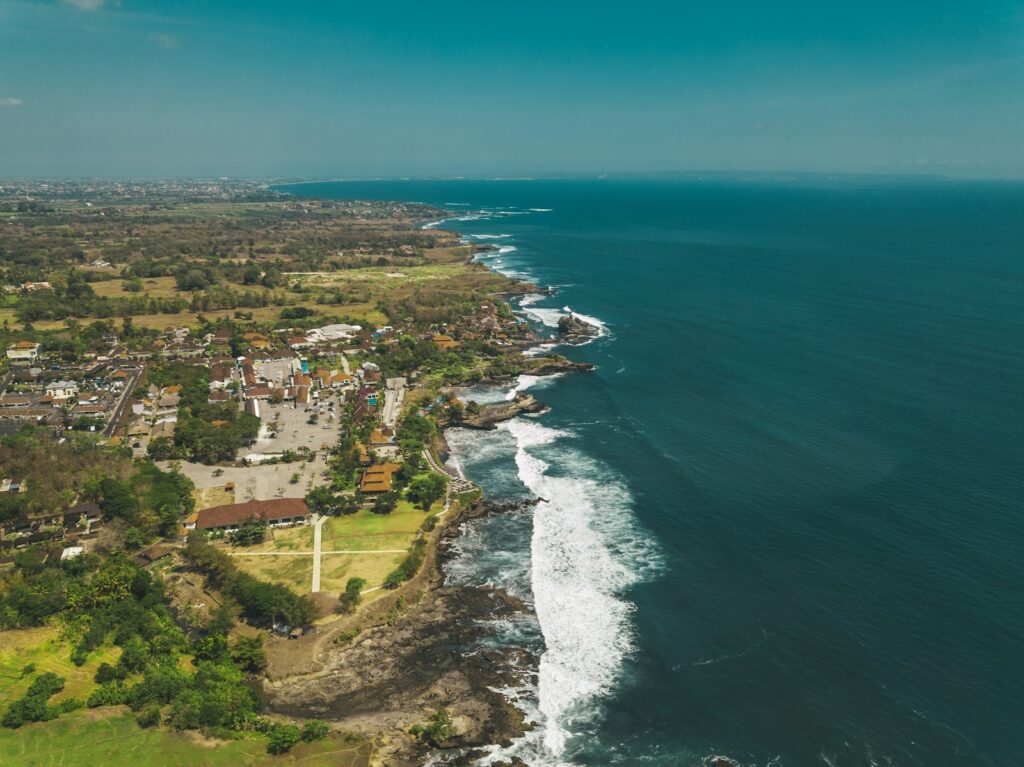
A helicopter ride over Bali’s Uluwatu at sunset costs roughly IDR 3,390,000–3,800,000 per seat (USD 215–250) for a shared 15-minute scenic circuit, or approximately IDR 25,000,000–27,000,000 per helicopter (USD 1,600–1,800) for a private charter flight. Those are the honest brackets—grounded in published operator rates—before we get into what “sunset timing” actually means, why most people book at the wrong hour, and what a premium departure window costs you on top of the base price.
The Uluwatu coastline is the single best argument for an aerial flight over South Bali. The Bukit Peninsula’s limestone cliffs drop sixty metres straight into the Indian Ocean. Uluwatu Temple perches on a sheer headland with water on three sides. No road gives you this angle. And the southwest orientation of those cliffs means that when the sun drops toward the horizon, the ochre rock face lights up in a way that no midday flight can replicate. Timing matters here more than on almost any other helicopter route in Bali.
This guide is sunset-specific. It covers the departure window, the light behaviour on the Bukit cliffs, the price premium that comes with a specifically timed evening circuit, and the photography logistics that separate a memorable flight from a mediocre one. For the full route and operator breakdown, the Uluwatu helicopter tour price guide is the companion read. For the head-to-head comparison of morning versus evening flights across all Bali routes, see the sunrise vs. sunset helicopter tour breakdown.
Why Sunset Works Differently on the Bukit Cliffs
Bali sits at roughly 8 degrees south latitude. Sunset times are stable—ranging from about 17:55 in June to about 18:30 in December—and the sun sets almost due west, with a slight seasonal lean toward the northwest in summer and southwest in winter. The Uluwatu headland faces southwest. That geometry is what makes sunset on this coastline genuinely exceptional from the air, rather than generically pretty.
At midday, the cliffs are lit from above. The limestone looks pale and flat. Shadows fall straight down, not across the face of the rock. The ocean reads as a broad blue expanse but lacks contrast. It’s clear and informative, useful for understanding the terrain, but photographically thin.
In the final 45 minutes before sunset, the angle shifts completely. Low oblique light rakes across the cliff face and produces the shadows that give the limestone its texture. The temple walls catch warm orange light on the west face. The sea turns from blue-green to burnished copper near the horizon, with deep teal farther out. The surf line against the reef shows up bright white. Haze, which can wash out Bali midday views, usually thins in the late afternoon as the sea breeze settles—though this is not guaranteed in the wet season.
The practical window for golden-hour light on the Bukit is the 30–45 minutes before actual sunset. For most of the year that means a flight departure between 17:00 and 17:30. This is earlier in June (aim for 17:15–17:30) and later in December (17:45–18:00). Fifteen-minute circuits leave roughly 10–12 minutes of airborne time over the coastline itself—enough to cover GWK, Melasti, Pandawa, and Uluwatu Temple in one pass, but not enough for extended orbiting over any single landmark.
The Sunset Route: What the 15-Minute Bukit Circuit Covers
The south Bukit coast route runs from the Ungasan heliport or Raffles Jimbaran helipad, tracking southwest along the cliff line and returning. In 15 minutes the aircraft typically passes:
- GWK – Garuda Wisnu Kencana: The 121-metre Vishnu-and-Garuda statue, visible from a wide area around South Bali, reads very differently from above. At sunset the gold accents on the statue catch the light directly. The limestone cultural park amphitheatre below casts long shadows east.
- Melasti Beach: A cliff-access-only white sand beach wedged between steep limestone walls. From the air the geometry is clear in a way it never is from the beach itself: the narrow channel between cliffs, the reef shelf just offshore.
- Pandawa Beach: The five carved Hindu deity statues in the cliff face are visible from low altitude. The beach curves below them. In late afternoon the carved faces catch the warm light directly.
- Uluwatu Temple: The pura sits on a narrow clifftop promontory with the Indian Ocean on three sides. This is the image most people have in mind when they book. At sunset the temple walls on the ocean-facing side catch the last direct light; the dark sea behind them makes the silhouette clean and distinct.
- Nyang Nyang Beach: On the return arc of a 15-minute circuit the pilot typically sweeps past Nyang Nyang—a long, empty beach accessible only via a 300-step cliff path from land. Isolated and completely uncrowded even in peak season, it photographs well as a contrast to Uluwatu’s drama just a few kilometres northeast.
The 10-minute taster does not reach Uluwatu Temple. It turns back after Pandawa. If the temple view at sunset is the specific image you are after, you need the 15-minute route or longer. Confirm the itinerary with your operator before booking—the naming of products varies between operators and the difference between a “south coast” and an “Uluwatu” product is exactly that extension southwest.
Sunset Helicopter Ride Bali Uluwatu Cost: Full Price Breakdown
Most operators list the same base rate for a 15-minute south coast circuit whether it departs at 10:00 or 17:00. The sunset premium—where it exists—comes from scheduling scarcity, not a different published tariff. Here is how the cost stacks up across the two purchasing models.
Per-Seat Shared Scenic Prices (2026)
| Duration | Route landmarks | IDR / seat (from) | USD approx. / seat |
|---|---|---|---|
| 10 min | GWK – Melasti – Pandawa (no temple) | IDR 1,990,000–2,290,000 | USD 125–155 |
| 15 min | GWK – Melasti – Pandawa – Uluwatu Temple – Nyang Nyang | IDR 3,390,000–3,800,000 | USD 215–250 |
The IDR figures above are based on Balicopter’s published from-rates—the most transparent pricing in this market. USD conversions assume IDR 15,000–16,000 per dollar; exchange rates move this bracket. Always confirm IDR pricing directly with your operator.
Private Charter Prices (Whole Helicopter, 4–5 Pax)
| Duration | IDR / flight (approx.) | USD approx. / flight | Per-person cost at 4 pax |
|---|---|---|---|
| 10 min | IDR 22,000,000–23,000,000 | USD 1,400–1,500 | ~USD 360–380 |
| 15 min | IDR 25,000,000–27,000,000 | USD 1,600–1,800 | ~USD 400–450 |
The 10-minute private figure is anchored in Raffles Bali’s published IDR 22.44M brochure rate. Effective hourly rate on a 10-minute block works out to approximately USD 8,000–9,000 per flight-hour—standard in rotorcraft charter globally because minimum block-time pricing is how aircraft economics work. You are not paying for ten minutes of fuel; you are paying for the aircraft’s availability and the crew’s time from preflight to shutdown.
The Sunset Scarcity Premium
Most operators do not publish a separate “sunset rate.” What they do is restrict the number of available sunset departures—typically one or two per evening depending on aircraft availability and last-light timing. In peak season (July–August, Christmas, and New Year), those slots fill 1–2 weeks out. In shoulder season (May–June, September–October) you can sometimes book 3–5 days ahead. In low season (November–March) the slots are available but weather variability is higher.
Where a premium does appear explicitly, it is usually charged for a specifically timed charter: if you want a private helicopter positioned to be over Uluwatu Temple at the exact moment of golden hour, you may pay 10–20% above the standard private charter rate for the scheduling coordination. This is the kind of detail that does not appear on operator websites—it comes out in a direct conversation.
If you want a specifically timed sunset flight—private, departure locked to golden hour—plan your trip with our concierge. We can confirm current operator sunset availability, verify whether the pricing includes the scheduling premium, and coordinate ground transfer from your hotel. WhatsApp planning is available if that is easier.
Hidden Costs to Watch For
The base seat price or charter rate is rarely the final number. These add-ons catch people who do not ask in advance:
- Indonesian VAT (PPN, 11%)
- Some operators quote net-of-tax and add it at checkout. Raffles Bali’s published rates appear tax-inclusive; standalone operators vary. Ask explicitly: “Is tax included in this price?” On a IDR 3,390,000 seat, 11% adds IDR 372,900—not trivial.
- Heliport handling fee
- Fly Bali’s Ungasan heliport (Jl. Pantai Melasti no. 8) is a registered facility. Some operators bundle the landing and handling fee; others list it separately. Confirm it is included in your quoted price.
- Ground transfer
- BaliLook advertises free ground transfers from Nusa Dua, Uluwatu, Ungasan, Jimbaran, and Pecatu. Other operators charge separately. If you are staying in Seminyak or Canggu—a 45–60 minute drive from Ungasan—factor in both the cost and the timing buffer: arriving at the heliport with 10 minutes to spare is not how you want to start a sunset flight.
- Minimum-passenger rules on “shared” departures
- Some operators require 2–4 passengers to operate a shared scenic departure. Book solo and you may be quietly upgraded to a partial-charter rate. Ask directly whether a single-ticket purchase is a guaranteed seat on a scheduled departure or contingent on filling the aircraft.
- Weight surcharge
- Fly Bali’s Nusa Penida transfer page states explicit total payload caps (passengers plus luggage). BaliLook’s general operation cap is 320 kg total; Fly Bali states 350 kg. Passengers significantly above 100–120 kg may incur a supplemental charge or trigger a seat-rebalance that affects who boards. Declare honestly at booking—this conversation is much easier on the phone than at the helipad.
Departure Points: Getting to the Heliport Before Dark
The two commercial departure points for south Bali helicopter operations are both on the Bukit Peninsula. For a sunset flight, your drive time to the heliport is part of the planning equation.
Ungasan Heliport (Fly Bali)
Jl. Pantai Melasti no. 8, Ungasan, Kuta Selatan 80363—approximately 1.5 nautical miles from GWK and 5.5 nautical miles from Ngurah Rai airport. This is marketed as the primary registered heliport in South Bali under Ministry of Transportation regulation PM 94/2015 (verify current DGCA status; regulatory designations can change). The Alila Uluwatu, Bulgari Bali, Banyan Tree, and Ayana resorts are nearby. Drive times to the heliport: Nusa Dua 15–20 minutes, Jimbaran 15–20 minutes, Seminyak 45–55 minutes, Canggu 60+ minutes. For a 17:15 departure, plan to leave Seminyak no later than 15:45.
Raffles Bali / Jimbaran Helipad
Raffles Bali operates an active hotel-based helipad in Jimbaran, used for their published scenic route portfolio. Access is typically through Raffles directly—either as a hotel guest or via a booked scenic package. The GWK helipad in Pecatu serves short transfers to and from properties on the upper Bukit. Neither is a public heliport; access is operator-managed.
Photography on a Sunset Uluwatu Flight
The 15-minute circuit does not give you time to be indecisive. You have roughly 10–12 minutes of active coastline flying. Plan your shots before you board.
What the Light Does at Each Landmark
GWK appears early in the flight, typically in the first 2–3 minutes. At 17:15–17:30 the statue’s west face is in warm direct light; the amphitheatre below is in shade. Shoot fast—you pass it quickly. Melasti and Pandawa follow. Melasti’s cliff walls glow amber; the beach itself stays in shadow between the cliffs until the sun is very low. Pandawa’s carved statues catch the late light well on the west-facing cliff.
Uluwatu Temple is the slowest-moving shot on the circuit: the pilot typically slows the approach and allows passengers a 20–30 second view before the aircraft turns. The temple walls on the ocean side are lit from the west; the ocean behind is dark teal and blue. If you are shooting a phone: wide mode first for the full peninsula context, then maximum optical zoom for the temple detail. A mirrorless camera with a 35–70mm range covers both shots without a lens swap.
Gear Rules and Doors-Off Options
Standard scenic flights run with doors on. Camera gear is unrestricted in the cabin beyond not obstructing the pilot’s controls or the safety equipment. Mirrorless cameras, DSLRs, and phones are all fine. Drones and action cameras on external mounts require specific clearance—confirm with your operator before the flight, not at the helipad.
Doors-off photography charters over the Bukit coast are available but are not a standard click-to-book product. Minimum 30–60 minutes, arranged via email or WhatsApp with operators that specifically offer aerial photography services. Harnesses, secured bags, and specific clothing requirements apply. The cost for a serious aerial photography or video charter over this route starts around USD 3,000 for 30–60 minutes and scales up with duration. Orbiting and hovering over specific landmarks burns more fuel and takes more flight time than a straight transit, hence the higher rate. For photography-specific charter planning, the doors-off helicopter photography guide covers the full logistics.
Composition Tips for the Temple Shot
The classic Uluwatu Temple aerial is taken from the southwest, with the temple in the left third of the frame and open ocean filling the right. Late afternoon sun enters from behind the aircraft on this approach angle, which means the temple’s west face and the cliff edge are both lit. The alternative composition—looking east from over the water back toward the temple—puts the sun in front of the aircraft and produces a silhouette. Both work; the silhouette is more dramatic, the lit-face version is more detailed. Tell your pilot which you want before departure, not while banking over the headland.
Sunrise vs. Sunset on the Uluwatu Route
This question comes up on every proposal or photography inquiry. The short answer: sunset wins for the Bukit.
Uluwatu’s cliffs face southwest. At sunrise, the sun rises behind the peninsula to the east—the cliffs are in shadow, the ocean ahead is backlit, and the temple is a silhouette with no detail. Sunrise light on the Bukit is aesthetically interesting but it is not “golden hour on the cliffs”—that is a sunset phenomenon exclusively. If your priority is lit, coloured limestone and a warm-toned Uluwatu Temple, sunset is the only correct timing.
For routes that face east—the Nusa Penida coast near Kelingking, or the east coast of Bali toward Amed—the calculus reverses. And for the volcano circuit over Mount Batur, sunrise is the strongly preferred option: morning air is calmer, the caldera is least likely to be cloud-capped, and the lake surface reflects predawn gold. Each route has its own directional logic. A sunset Batur flight is not wrong, but it gives up the best light. A sunrise Uluwatu flight is technically fine and cheaper (slot availability is higher) but does not deliver the experience most people have in mind.
For the full head-to-head across every Bali route, the sunrise vs. sunset guide goes into the directional analysis route by route.
Booking the Sunset Slot: Practical Steps
Sunset slots operate on a short window and operators do not advertise them prominently. Here is how to secure one without getting bumped to a midday departure.
First, book early. In July and August, peak Indonesian school holidays and peak international travel season overlap. Sunset slots on Friday and Saturday evenings can be full a week out. In April, May, September, and October—shoulder dry season—three to five days is usually enough lead time. In the wet season (November–March) availability is higher but weather confidence is lower.
Second, confirm the departure time is sunset-specific. Say exactly: “I want a departure between 17:00 and 17:30 to catch golden hour over Uluwatu.” Do not assume a “late afternoon” or “evening” description maps to the correct light window. Some operators schedule last departures at 16:30—BaliLook’s published operating window closes there. That is 60–90 minutes before sunset, which means Bukit light that is better than midday but not yet golden. A 16:30 departure gives warm-afternoon light; a 17:15 departure gives golden hour. The difference matters.
Third, have a weather fallback plan. Short-circuit scenic flights are VFR operations. Low cloud over the Bukit, common in the wet season and occasional in dry-season afternoons, will cause a reschedule or cancellation. Ask the operator two things before you pay: what their weather go/no-go criteria are, and whether a weather cancellation produces a full refund or a rescheduling credit. Reputable operators do one or both. If the answer is “we assess on the day and there are no refunds,” that is a flag.
Fourth, factor the drive. Arriving at the Ungasan heliport flustered from traffic with 5 minutes to spare is not how you want this experience to start. Add 20 minutes buffer to your calculated drive time from your hotel during peak hour (16:00–17:30), especially from Seminyak or Kuta where southbound traffic toward the Bukit can stack up at the Bypass Ngurah Rai intersections.
Need help confirming operator availability for a specific sunset date? Plan your trip with our team—or send a WhatsApp and we’ll come back with verified slot availability and pricing within a few hours.
Is the Sunset Premium Worth It?
The base price difference between a midday and a sunset flight is usually zero—same tariff, different slot. What you pay the premium for is the effort of securing the slot, the drive timing, and the planning. In return, the Bukit cliffs in the last 40 minutes of daylight look categorically different from the same route at noon. The light is not a minor improvement; it is the difference between a good view and a photograph that earns a double-take.
For a couple on a once-a-trip splurge, the sunset 15-minute shared circuit at IDR 3,390,000–3,800,000 per person (USD 215–250) is the clearest value case in the Bali helicopter market. Short enough to be affordable. Timed precisely for the best light the Bukit produces. And the Uluwatu Temple shot from above in warm gold light is not replicable from the ground at any price.
Frequently Asked Questions
What is the best time for a sunset helicopter ride over Uluwatu?
The golden-hour window for Uluwatu’s southwest-facing cliffs runs roughly 30–45 minutes before actual sunset. Bali sunsets fall between about 17:55 in June and 18:30 in December, so the ideal departure for a 15-minute circuit is typically 17:00–17:30 depending on the time of year. Most operators’ standard schedules close at 16:30; a specifically timed sunset circuit requires direct booking confirmation. Book 1–2 weeks ahead in peak season.
How much does a sunset helicopter ride over Uluwatu cost in 2026?
There is typically no separate “sunset surcharge”—the base rate applies. For the 15-minute south Bukit circuit that includes Uluwatu Temple, shared per-seat prices run from approximately IDR 3,390,000 to IDR 3,800,000 per person (USD 215–250 at current exchange). A private charter for the same 15-minute route costs roughly IDR 25,000,000–27,000,000 per helicopter (USD 1,600–1,800). Figures are based on Balicopter’s published rates and Raffles Bali’s brochure pricing; confirm directly, as rates adjust seasonally.
Does the 10-minute Uluwatu helicopter tour reach the temple at sunset?
No. The 10-minute south coast taster covers GWK, Melasti Beach, and Pandawa Beach, then turns back before reaching Uluwatu Temple on the far southwest tip of the peninsula. To see the temple—and particularly to photograph it with sunset light on the west face—you need the 15-minute “Uluwatu Skyline” circuit or longer. The price difference between 10 and 15 minutes is approximately IDR 1,100,000–1,500,000 per seat (USD 70–100): a small uplift for a meaningfully different experience if the temple is your goal.
Is sunrise or sunset better for a Uluwatu helicopter flight?
Sunset. The Bukit Peninsula’s cliffs face southwest, which means they receive direct warm light in the evening and sit largely in shadow at sunrise. A sunrise flight over Uluwatu gives you a silhouetted temple against a backlit sky—dramatic in its own way but without the warm cliff-face textures and gold-on-limestone tones that make the sunset version so distinctive. For routes facing east—Kelingking Beach on Nusa Penida, or the Amed coastline—sunrise is the correct choice. For the Bukit and Uluwatu, sunset is clearly the stronger option.
What should I bring on a sunset helicopter flight over Uluwatu?
A fully charged phone or camera. A wide-angle or standard zoom lens if you shoot mirrorless (24–70mm equivalent handles both the full-peninsula vista and closer temple detail). Secure your camera strap before boarding. Wear close-toed shoes (standard heliport safety requirement) and avoid loose scarves or hats that can move inside the cabin. The flight is 15 minutes so you do not need food or water, but arriving 15–20 minutes early lets you settle, hear the safety briefing clearly, and get your preferred seat—typically the window side facing the coast on the outbound leg.