How we stay independent: Bali Helicopter Price is not an operator and earns no commission on the prices shown. If you use our free booking help, we may receive a referral fee from the operator at no extra cost to you. It never changes the figures we publish.
A sunrise Bali helicopter tour gives photographers the softest, most directional light of the day and the calmest air of any flight window — but it demands an early alarm, limited operator availability, and a willingness to commit before you know what the weather will do. A sunset flight offers warmer golden tones, easier logistics, and the chance to watch the sky change colour over Uluwatu or Kelingking in real time — at the cost of thermals that build through the afternoon and a narrower, more turbulent flight window. Neither slot is universally “better.” Which one works depends on your route, your camera priorities, and your tolerance for the tradeoffs covered below.
Why Light Timing Matters More Than Most Tour Operators Admit
Helicopter operators in Bali typically run scenic flights between 10:00 and 16:30 — a window dictated by DGCA VFR minimums and site permits, not by what flatters a coastal cliff shot. Within that window, the light at 10:00 and the light at 16:00 are very different from each other, and both differ sharply from the hour just after dawn.
Bali sits at roughly 8 degrees south, so the sun rises hard and fast. By 07:30 you have soft, low-angle light raking across the Bukit Peninsula limestone faces and catching the far side of Kelingking's T-Rex headland. By 10:00 — when most standard tours launch — the sun is already high enough to blast highlights into the white sand and flatten the texture of sea cliffs. By 14:00 on a clear day you're shooting into heat shimmer and blown-out sky.
Sunset reverses some of that. The last hour before the sun hits the horizon returns low-angle warmth. But Bali's afternoon weather pattern — sea breezes building from around noon, cumulonimbus cells developing over the central mountains by mid-afternoon — means the tail end of the operating window is the roughest and most unpredictable for flying. The light gets beautiful right as the air gets bumpy.
This tension shapes almost every practical decision on a photography-focused flight.
Air Stability: Morning Wins, but by How Much?
Thermal turbulence builds with surface heating. Over limestone headlands like the Bukit Peninsula and the cliffs of Nusa Penida, surfaces heat quickly, so thermals can punch noticeably by late morning. Over the sea itself, conditions stay more benign longer. Over Batur's caldera and the central volcanic terrain, afternoon convection is more pronounced — afternoon cloud can obscure the crater rim entirely, and the ride in can be rough enough to blur a long telephoto shot.
Early morning flights — typically achievable only on private charter arrangements with operators willing to launch before 09:00 — catch the overnight drainage winds settling, surface heating barely started, and (on clear days) a glass-calm layer at low altitude over the coast. For aerial photography purposes, less vibration means you can hold a slower shutter speed without motion blur from the aircraft. Over Nusa Penida in still morning air, you can realistically shoot at 1/250s with a 200mm lens if you brace properly. In afternoon chop over the same route, you'd want 1/1000s or faster to get a clean result at the same focal length.
The practical gap: on a standard 10:00–16:30 operator schedule, the closest approximation to "morning light" is the 10:00 first-slot departure. It's not golden hour, but it's meaningfully better than a 14:00 slot on a clear day. If you can arrange a private charter and discuss a launch window with the operator, ask about 08:00–09:00 departures specifically.
Route-by-Route: Which Slot Serves Your Shot
South Coast and Uluwatu Cliffs (10–15 min)
The short southern Bukit circuit — GWK, Melasti, Pandawa, and the Uluwatu headland — faces mostly west and southwest. This is classic sunset territory. The cliffs catch the orange light from behind you as you fly west in the late afternoon, and Uluwatu Temple's silhouette against an orange-pink sky is the textbook image from this route. At sunrise, the cliffs are in shade from the east-facing flight path: you get atmospheric softness but the faces stay dark. If your goal is the iconic Uluwatu cliff-face shot with dramatic sky behind, take the late-afternoon slot. If you want to shoot texture and shadow detail on the rock formations without blown-out sky, morning has the edge.
Pricing for this short route: shared seat tours run roughly IDR 2,290,000–3,390,000 per person (approximately USD 145–215 at current rates) for 10–15 minutes; private charter for the same circuit starts around IDR 22–26 million (USD 1,400–1,700) for the full helicopter. Confirm with your operator whether the last slot is at 16:00 or 16:30 and how close to sunset that actually puts you — it varies by season.
Nusa Penida: Kelingking, Broken Beach, Devil's Tears (42–55 min)
The Nusa Penida route is the most technically demanding for photography and the one where the light timing decision matters most. Kelingking's headland faces northwest; Diamond Beach and Atuh face east and southeast; Broken Beach is roughly north-facing. A 42–55 minute circuit will cross all of them, and their orientations mean you cannot get front-lit shots of every landmark in a single pass regardless of time of day.
Morning departures do well at Atuh and Diamond Beach — those east-facing cliffs pick up clean front light early, with deep teal water in the shadow zones. Kelingking at dawn is lit from behind, giving a moody silhouette over the peninsula rather than the fully-lit green T-Rex profile you see in most Instagram posts. Afternoon flights reverse that: Kelingking is fully front-lit from mid-afternoon, and the blues in the water west of the headland are vivid by 14:00–15:00. At sunset, Kelingking can be spectacular — if the weather holds.
The catch is the aerial distance. Nusa Penida sits roughly 20 km southeast of South Bali's helipads. A 45-minute tour means about 20 minutes in transit each way and only 5–10 minutes orbiting the actual landmarks. Afternoon convection and the sea breeze accelerate turbulence over the Badung Strait crossing, particularly after 14:00. Operators' weather cancellations are more frequent on this route in the wet season (roughly November through March) and on the late-slot departures of the shoulder months.
Shared seat pricing for this route: roughly IDR 8,990,000–10,990,000 per person (USD 565–700). Private charter runs IDR 38–46 million (USD 2,400–2,900) for the aircraft. This is where the math on private vs shared often tips: four people on a private charter can each pay less per head than four individual shared seats while gaining the flexibility to negotiate your slot time.
Ready to lock in the right slot for your Nusa Penida shoot? Plan your trip with our concierge — we can tell you which operators currently offer pre-10:00 departures and whether the late slots have had recent cancellation issues.
Mount Batur and the Volcanic Interior (30–75 min)
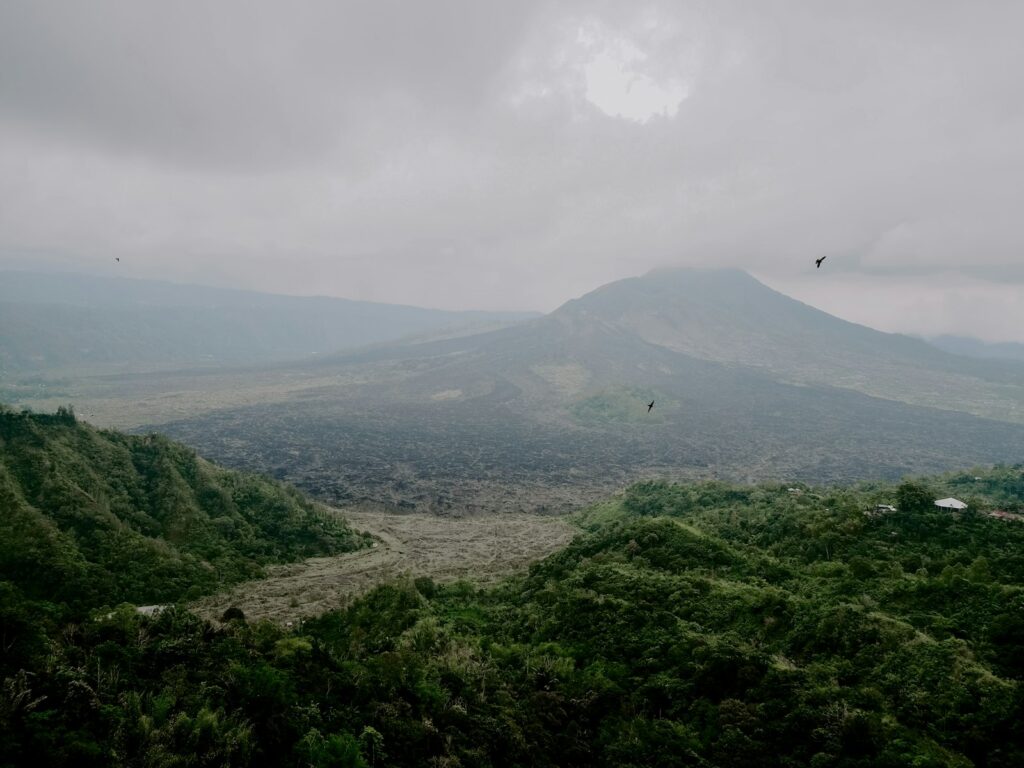
The volcano route is the clearest case where sunrise wins, and it's not close. Batur's caldera faces east and is most photogenic when low sun catches the crater rim and reflects off Lake Batur in the valley below. By 10:00 on a cloud-free morning, this can still be good. By early afternoon, cumulus develops rapidly over the 1,717-metre summit and the lake frequently disappears under haze. By 15:00 on many dry-season afternoons, the caldera view is partially or fully obscured.
The 30-minute Mason Adventures circuit (Batur + caldera lake) is the shortest version, while longer 60–75 minute routes add Ubud's rice terraces, the UNESCO Jatiluwih landscape, and Tanah Lot Temple on the west coast. The extended versions are less dependent on a single landmark, but the volcano section still rewards early flight. If you can get a morning private charter, this is the strongest argument for it across any route in Bali.
Pricing context: a 45–55 minute Batur-focused tour runs approximately IDR 10,990,000 per seat on shared pricing (around USD 690). A private charter for a 60–75 minute grand-tour circuit runs IDR 61–66 million (USD 3,800–4,200) for the helicopter.
Ubud, Rice Terraces, and Tanah Lot (45–75 min)
Ubud's terraced landscape and the Ayung River gorge are interior, shaded by surrounding hills, and benefit from morning light angling in from the east. The Tegallalang terraces face roughly southeast — they pick up clean, indirect morning light that brings out the layered green structure without harsh shadows. By mid-afternoon, this terrain goes flat and green-on-green contrast is harder to work with.
Tanah Lot, on the west coast, reverses the logic: it is silhouetted best at sunset when the sun drops toward the Indian Ocean behind the temple. A long-route 60+ minute flight that includes both Batur and Tanah Lot will have one landmark in optimal light and one in compromise — that's unavoidable. If Tanah Lot is the shot you care about, a late-slot grand tour is your call. If Batur and Ubud matter more, go morning.
The Practical Comparison Table
| Factor | Sunrise / Early Morning | Sunset / Late Afternoon |
|---|---|---|
| Light quality | Soft, directional, low contrast — easier to expose | Warm golden tones, high drama, harder to expose cliffs + sky together |
| Air stability | Calmest of the day; drainage winds settled | Thermals and sea-breeze turbulence building; rougher over cliffs and mountains |
| Cancellation risk | Lower — cleaner air, less convective buildup | Higher — afternoon thunderstorms in wet season, haze in dry season |
| Operator availability | Limited — most run from 10:00; pre-09:00 requires private charter negotiation | Standard — final slots 15:30–16:30 on most operators |
| Best for: Uluwatu cliffs | Texture + shadow detail, no blown-out sky | Orange/pink sky backdrop — the classic shot |
| Best for: Nusa Penida / Kelingking | Atuh + Diamond Beach front-lit; Kelingking silhouette | Kelingking front-lit, vivid water colours |
| Best for: Mount Batur | Clear caldera, lake reflection, minimal haze — strongly preferred | Frequent cloud cover, less recommended |
| Best for: Tanah Lot | Temple in shadow — less dramatic | Classic silhouette over ocean — strongly preferred |
| Crowd / noise below | Near-empty sites, quieter visual below | Beach clubs, surf crowds visible on cliff routes |
| Price premium | Some operators charge a small early-departure surcharge; confirm | Standard rack rate applies |
What Changes in the Wet Season
Bali's wet season runs roughly November through March. During this period, the gap between the two slots widens in a direction that surprises some visitors: early morning often has the clearest skies of the day, because overnight convection dissipates before dawn and the next round of thunderstorms doesn't build until the afternoon. Sunrise or 09:00 departures can offer genuinely blue-sky views, while a 15:00 slot on the same day might face curtains of rain from the mountains and zero visibility over Batur.
Sunset flights in the wet season carry higher same-day cancellation rates, especially on interior routes (Batur, Ubud, Kintamani) and the Nusa Penida crossing. Operators make go/no-go calls typically within two to four hours of departure. Reputable operators will reschedule or credit; some have stricter cancellation terms during peak December-January weeks when flights are fully booked. If you're travelling November through March and photography is the primary goal, lean toward the morning slot and take the risk of less-dramatic light in exchange for a higher probability of actually flying.
Doors-Off Flights: The One Situation Where You Must Specify the Slot
Doors-off aerial photography charters are booked separately from standard scenic tours — they require prior arrangement, usually via email or WhatsApp with the operator, not a standard click-to-book flow. On these flights, the time slot is not a preference; it's the core deliverable. Serious aerial photographers targeting Kelingking's headland or the Uluwatu cliffs for commercial or editorial work should request a 07:30–09:00 launch and be specific about the orbit directions they need from the pilot.
Doors-off flights typically run 60–120 minutes minimum, and hourly rates for this configuration are higher than standard scenic tours — broadly in the range of USD 3,000–5,000 for a full session, depending on the operator and route. The aircraft must be approved for doors-off configuration, harnesses are mandatory, and clothing/gear rules apply. Discuss all of this with the operator before booking. See our detailed doors-off photography flight guide for camera gear rules and what to ask operators before you commit.
Planning Notes: Timing, Lead Time, and What to Ask
Bali's peak flying periods are July, August, and the Christmas-New Year fortnight. During these windows, sunset slots on the Nusa Penida and Uluwatu routes book one to two weeks ahead, and private charters for non-standard times book even faster. If you need a specific morning departure for a photography session, start the conversation with operators at least two weeks out in peak season and four to seven days out in shoulder season.
Things to confirm when you book for photography purposes specifically:
- What is the earliest departure time available? (Standard vs charter)
- Does the quoted price include tax? (Some operators quote net inclusive; others add 10–21%)
- What is the cancellation and rescheduling policy for weather? (Particularly important for wet-season or Batur flights)
- Is the aircraft approved for doors-off, and what are the gear and clothing requirements?
- Which direction will the pilot orbit key landmarks — and will you be on the correct side of the aircraft for the angle you need?
On the last point: in a shared scenic tour you typically cannot dictate your seat position or orbit direction. On a private charter you can. This alone, separate from the light timing question, is a strong reason to book private if photography is your primary goal.
Want a second opinion on which slot and route makes sense for your specific shoot? Plan your trip via our concierge — tell us your route priorities and whether you need doors-off access, and we can point you toward the operators currently offering those arrangements. WhatsApp planning works well for photography charters where the details matter: message us with your dates, route, and camera goals.
FAQs
Is sunrise really available on standard Bali helicopter tours, or do I need a private charter?
Most operators' standard published schedules start at 10:00, which is past golden hour even in summer. True sunrise departures — around 06:00–07:30 depending on the season — typically require a private charter booked directly with an operator who is willing to negotiate the launch time. Ask specifically; a few operators accommodate this for morning photography bookings, especially for longer sessions of 60 minutes or more. Do not assume a "first slot" booking gives you sunrise light — the 10:00 first slot gives you midmorning light at best.
Will there be more turbulence at sunset than in the morning?
Generally yes, particularly over land and cliff routes. Thermal turbulence builds with surface heating through the day and tends to be strongest between 13:00 and 16:00, which overlaps with the late afternoon flying window. The Badung Strait crossing to Nusa Penida and the Batur caldera approach are the two routes where afternoon turbulence is most noticeable. Over the open coast on a calm dry-season day the difference is smaller. If motion sickness is a concern for any member of your group, an earlier slot is lower risk.
Does weather cancel more sunset flights than sunrise flights in Bali?
During the wet season (roughly November to March), yes — afternoon cancellation rates are meaningfully higher than morning ones because convective thunderstorms typically build between 13:00 and 17:00. In the dry season (April to October), same-day cancellations are less common but late-afternoon haze can reduce visibility over the central mountains. Operators give go/no-go decisions typically two to four hours before departure, so a 16:00 sunset slot gets a decision around noon on the same day. A 10:00 morning slot gets its decision around 06:00–08:00 when conditions are often clearer.
Which route is best for a photography flight if I can only do one?
The Nusa Penida circuit (42–55 minutes, covering Kelingking, Broken Beach, Devil's Tears, and Manta Point) is the most photographically diverse single route in Bali — multiple landmark types, dramatic cliff geometry, and saturated water colours. For pure geological drama in one frame, it has no competition. The tradeoff is that it is the most expensive route at shared prices of roughly IDR 8,990,000–10,990,000 per seat (USD 565–700), and it is the most weather-sensitive on the afternoon slot. If budget is a constraint, the 15-minute Uluwatu circuit at IDR 3,390,000 per seat (USD 210–215) is a legitimate introduction, but understand you are getting the cliffs and coastline only — no volcano, no Nusa Islands.
Can I bring a professional camera and long lens on a Bali helicopter tour?
On a standard closed-door scenic tour, cameras with lenses up to roughly 200mm are generally accommodated, though each operator has their own rules on bag dimensions and strap requirements (gear must be secured to your body, not left loose in the cabin). Wide to standard zoom lenses are the practical choice for closed-door shooting. For longer telephoto work or a drone-style wide field of view, a doors-off charter with a harness is the correct setup — not a standard tour. Confirm camera dimensions and any lens length restrictions at booking, not at the helipad. For a full breakdown of what gear is allowed and how to shoot from each aircraft type, see our guide to camera gear for doors-off helicopter flights in Bali.